

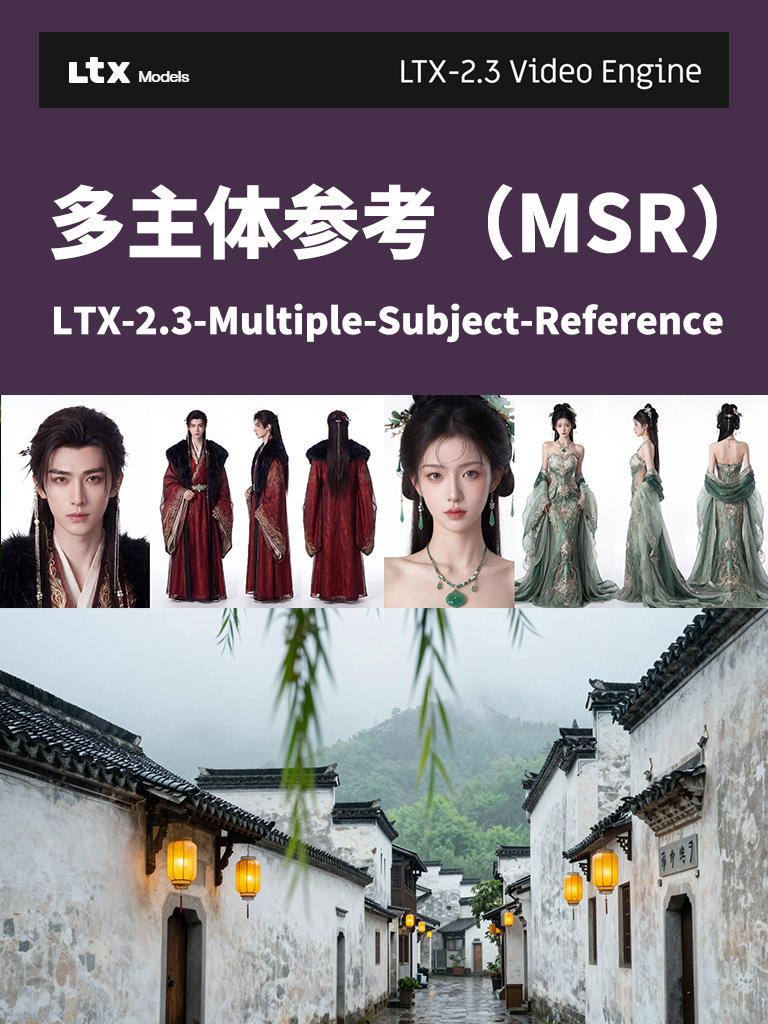
多主体参考 LTX-2.3-Multiple-Subject-Reference
Model Information
Multi-Subject Reference Video Generation
LTX-2.3-Multiple-Subject-Reference
Workflow URL: https://www.RunningHub.cn/post/2065248408478248962
Based on Multiple Subject Reference (MSR), this model proposes a brand-new multi-reference image video generation solution. This approach eliminates the need for additional encoder branches or feature fusion modules, instead converting multiple static reference images into pseudo-video sequences to place them in the same feature representation space as the target video.
Instructions
This LoRA model must be used with the ComfyUI-Licon-MSR plugin in ComfyUI. An example workflow is included in the model files for quick testing and debugging.
----------------------------------------
Key Features
Multi-Reference Visual Memory
Token-Level Reference Retention: Encodes multiple reference images into video latent space features, retaining fine visual details at the token dimension rather than compressing them into a single feature embedding.
Native Self-Attention Retrieval: Target video tokens can directly retrieve reference image tokens through the model's native self-attention mechanism without modifying the model architecture.
Contextual Condition Constraints: Reference content is integrated into the primary token sequence as "visual memory" rather than as an independent external condition input.
Flexible Reference Image Combination
Supports 2–5 reference image inputs, adapting to generation scenarios of varying complexities.
Each reference image can carry differentiated semantic information:
Subject identity features
Prop / object details
Scene and background
Local textures
Multi-angle footage
Functional capabilities
Cross-Reference Identity Retention
Retains subject features from multiple reference images simultaneously in the generated video:
Blending multiple characters from different reference images
Combined generation of characters and objects
Fusion creation of objects and scenes
Content Combination Based on Association Relationships
Beyond basic identity retention, the model can reorganize reference content according to the associative logic described in the text:
Action interactions (passing, picking up, pushing, etc.)
Spatial positional relationships (left-right distribution, foreground/background hierarchy)
Temporal event logic (start → process → result)
Cross-Reference Attribute Selective Extraction
The model can intelligently select and fuse corresponding visual attributes from different reference images:
Facial features from reference image A, apparel features from reference image B
Object subject retained from one reference image, posture/position taken from another
Background elements calling upon scene-type reference content
Tips for Use (V1 Version)
Prompt Writing: Descriptions of reference images should be concise and precise; excessive descriptions or insufficient information will lead to decreased visual consistency.
High-Dynamic Footage: It is recommended to set the frame rate to 50 frames per second to ensure smooth and coherent dynamic footage.
Generation Stability: Typically, 2–3 rounds of repeated sampling will yield accurate finished results.
Multi-Subject Reference Video Generation
LTX-2.3-Multiple-Subject-Reference
Workflow URL: https://www.RunningHub.cn/post/2065248408478248962
Based on Multiple Subject Reference (MSR), this model proposes a brand-new multi-reference image video generation solution. This approach eliminates the need for additional encoder branches or feature fusion modules, instead converting multiple static reference images into pseudo-video sequences to place them in the same feature representation space as the target video.
Instructions
This LoRA model must be used with the ComfyUI-Licon-MSR plugin in ComfyUI. An example workflow is included in the model files for quick testing and debugging.
----------------------------------------
Key Features
Multi-Reference Visual Memory
Token-Level Reference Retention: Encodes multiple reference images into video latent space features, retaining fine visual details at the token dimension rather than compressing them into a single feature embedding.
Native Self-Attention Retrieval: Target video tokens can directly retrieve reference image tokens through the model's native self-attention mechanism without modifying the model architecture.
Contextual Condition Constraints: Reference content is integrated into the primary token sequence as "visual memory" rather than as an independent external condition input.
Flexible Reference Image Combination
Supports 2–5 reference image inputs, adapting to generation scenarios of varying complexities.
Each reference image can carry differentiated semantic information:
Subject identity features
Prop / object details
Scene and background
Local textures
Multi-angle footage
Functional capabilities
Cross-Reference Identity Retention
Retains subject features from multiple reference images simultaneously in the generated video:
Blending multiple characters from different reference images
Combined generation of characters and objects
Fusion creation of objects and scenes
Content Combination Based on Association Relationships
Beyond basic identity retention, the model can reorganize reference content according to the associative logic described in the text:
Action interactions (passing, picking up, pushing, etc.)
Spatial positional relationships (left-right distribution, foreground/background hierarchy)
Temporal event logic (start → process → result)
Cross-Reference Attribute Selective Extraction
The model can intelligently select and fuse corresponding visual attributes from different reference images:
Facial features from reference image A, apparel features from reference image B
Object subject retained from one reference image, posture/position taken from another
Background elements calling upon scene-type reference content
Tips for Use (V1 Version)
Prompt Writing: Descriptions of reference images should be concise and precise; excessive descriptions or insufficient information will lead to decreased visual consistency.
High-Dynamic Footage: It is recommended to set the frame rate to 50 frames per second to ensure smooth and coherent dynamic footage.
Generation Stability: Typically, 2–3 rounds of repeated sampling will yield accurate finished results.