

Nano Banana 2 Lite API Model Guide for Fast AI Image Generation
Explore the key capabilities and best use cases of Nano Banana 2 Lite API, and learn how teams can use RunningHub’s text-to-image API for product images, ad creatives, and visual content workflows.
Nano Banana 2 Lite API Model Guide for Fast AI Image Generation
For developers, e-commerce platforms, creative tools, and enterprise teams, choosing an image generation API is not only about image quality. Speed, scalability, prompt following, cost efficiency, and workflow fit all matter when a model needs to support real production tasks.
Nano Banana 2 Lite API is a text-to-image model API available on RunningHub. It is designed for teams that need to generate visual assets quickly, test multiple creative directions, and build image generation into product or business workflows.
According to Google’s official announcement, Nano Banana 2 Lite is the fastest and most cost-efficient Gemini Image model in the Nano Banana family, built for high throughput, speed, and scale. On RunningHub, this model is available as a text-to-image API, making it useful for product images, ad creatives, social media visuals, design drafts, and high-volume visual content workflows.
This guide explains what Nano Banana 2 Lite API is, what its core model capabilities are, which scenarios it fits best, and how teams can start using it from the RunningHub API page.
Try Nano Banana 2 Lite API on RunningHub
What Is Nano Banana 2 Lite API?
Nano Banana 2 Lite API is a text-to-image API for generating images from written prompts. Instead of manually creating every image asset one by one, teams can describe what they need in a prompt and use the API to generate visual outputs more efficiently.
The model is especially useful when a workflow needs speed and scale. For example, an e-commerce tool may need to create multiple product image directions. A marketing team may need several ad creative variations. A design platform may want to generate quick visual drafts for users. In these cases, a fast image generation API can help teams move from idea to visual result much faster.
On RunningHub, the Nano Banana 2 Lite API page presents the model as a text-to-image official stable API. The page also provides access to model information, API usage details, Playground, and pricing-related sections, so users can evaluate the model before using it in their own workflow.
Key Model Capabilities of Nano Banana 2 Lite API
Nano Banana 2 Lite API is not positioned as a heavy, slow, one-off image model. Its value is in fast visual generation, high-volume use, and efficient creative iteration. These capabilities make it a strong fit for API-based image workflows.
1. Fast Text-to-Image Generation
The first major advantage of Nano Banana 2 Lite API is speed. When teams generate images inside an application, dashboard, or internal content system, waiting too long for every result can hurt the user experience.
A faster text-to-image API is useful when users need to test ideas quickly, generate multiple options, or produce images as part of a larger creative pipeline. This makes Nano Banana 2 Lite API suitable for fast product image generation, ad creative exploration, and social media content workflows.
2. Built for High-Throughput Workflows
API use cases are different from single-user manual generation. A product or business workflow may need to handle repeated requests, multiple users, and batch generation tasks. Nano Banana 2 Lite is designed for high throughput, speed, and scale, which makes it better suited for production-style image generation workflows.
This is useful for SaaS tools, e-commerce systems, creative platforms, content automation tools, and internal marketing systems that need to generate many visual options efficiently.
3. Cost-Efficient Creative Iteration
Creative teams rarely find the final image in one attempt. They usually need to explore different backgrounds, compositions, styles, and use cases before choosing the best result.
Nano Banana 2 Lite API is useful for this early creative stage because it helps teams generate multiple image directions quickly. Instead of spending too much time on one version, users can create several options, compare them, and then refine the best one.
4. Prompt-Driven Image Generation
Because Nano Banana 2 Lite API is a text-to-image model, the prompt becomes the main way to control the result. This makes it suitable for productized workflows where prompts can be generated from structured business data.
For example, an e-commerce platform can turn product names, selling points, categories, campaign themes, and target platforms into prompt templates. A design tool can let users choose a style, background, and layout, then generate image results automatically.
5. Useful for Productized AI Image Workflows
The biggest value of Nano Banana 2 Lite API is not only that it can generate images. It can also become part of a larger product workflow. Developers can use it inside creative apps, e-commerce tools, marketing systems, AI agents, or internal content platforms.
Best Use Cases for Nano Banana 2 Lite API
Nano Banana 2 Lite API is best suited for use cases that need fast, repeatable, and scalable visual generation. It is not limited to one creative category. Instead, it can support several business-facing image generation scenarios.
Product Images for E-commerce
E-commerce teams often need more than one product visual. A product may need a main image, campaign image, lifestyle image, ad image, and social media version. With AI product image generation, teams can use prompts to explore different visual directions more quickly.
Nano Banana 2 Lite API is a good fit for generating product image concepts, product posters, campaign visuals, and visual drafts for online stores.
Ad Creative Generation
Marketing teams need to test many creative directions. Different backgrounds, color palettes, compositions, and messages can affect performance. A fast image generation API can help generate multiple ad creative ideas before designers or marketers refine the final versions.
This makes Nano Banana 2 Lite API useful for campaign ideation, A/B testing assets, promotional visuals, and platform-specific ad image variations.
Social Media Visuals
Social media content needs constant visual updates. Teams may need covers, thumbnails, post images, campaign teasers, or topic-based visuals. Nano Banana 2 Lite API can support tools that generate images for social media workflows at scale.
Design Drafts and Visual Exploration
In the early stage of a design project, teams often need multiple visual directions before committing to one. Nano Banana 2 Lite API can help generate concept images, moodboard-style visuals, key visual drafts, and layout ideas faster.
How to Use Nano Banana 2 Lite API on RunningHub
This article is not a low-level API integration tutorial. Instead, it is a model guide that helps users understand what Nano Banana 2 Lite API is best for and how to start exploring it on RunningHub.
To evaluate the model, open the Nano Banana 2 Lite API page on RunningHub. From there, you can review the model description, check the available API information, explore the Playground, and understand whether the model fits your image generation needs.
The RunningHub page helps users evaluate the model from several angles:
For official usage details, always follow the current information shown on the RunningHub API page.
[RunningHub Nano Banana 2 Lite API page]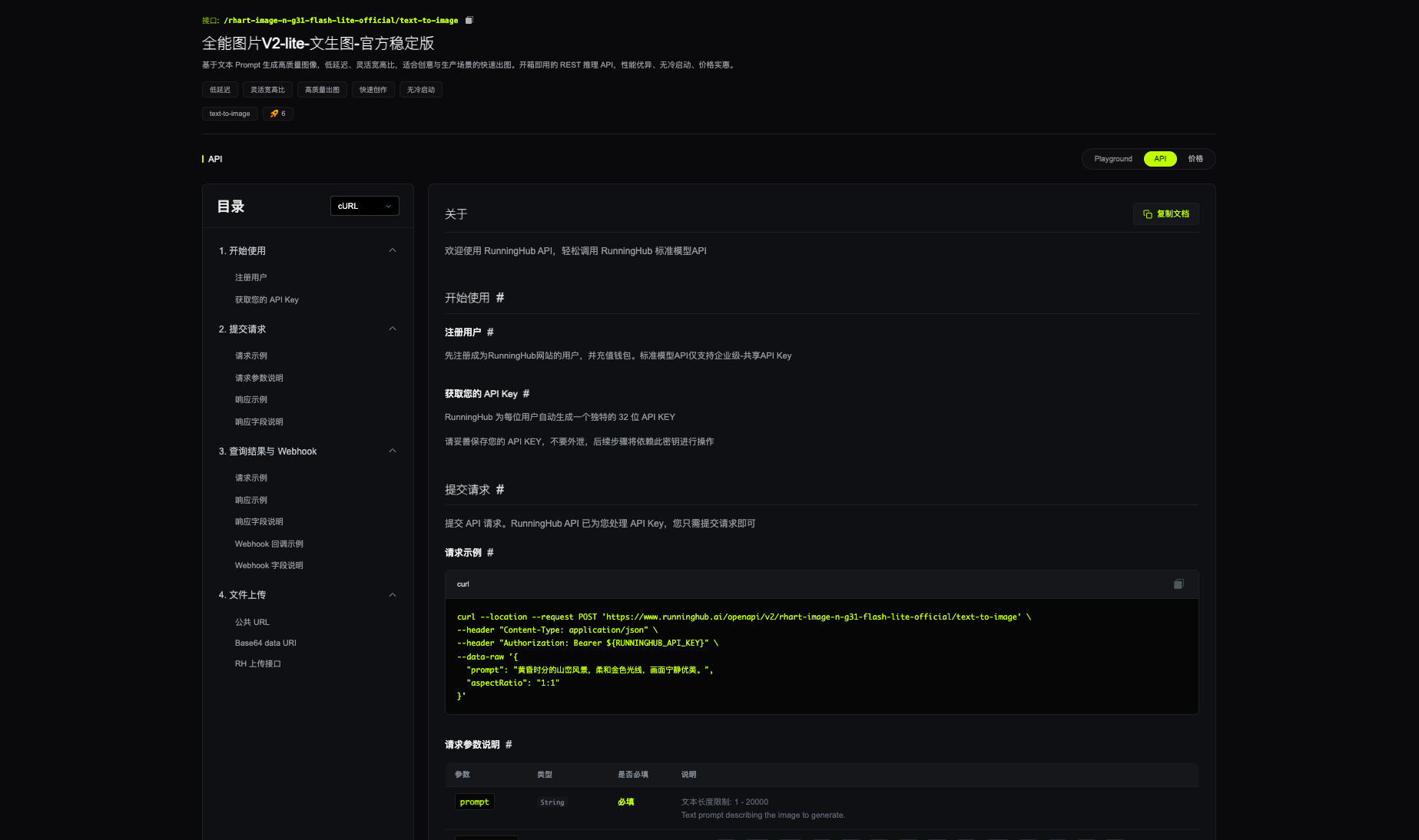
Prompt Structure for Nano Banana 2 Lite API
For a text-to-image API, prompt quality has a direct impact on the output. A good prompt should not only describe the subject, but also explain the use case, style, composition, and output requirements.
Use this structure when writing prompts for business image generation:
Subject + Use Case + Scene + Style + Composition + Lighting + Output Requirement + Constraints
Subject: The main object or concept, such as a product, poster, cover image, or design draft.
Use case: Where the image will be used, such as an e-commerce product page, ad campaign, social media post, or landing page.
Scene: The environment or background, such as a clean studio, summer setting, futuristic space, or minimal product display.
Style: The visual direction, such as premium commercial, clean e-commerce, tech-inspired, fresh lifestyle, or luxury editorial.
Composition: The layout, such as centered product, clean negative space, close-up view, vertical format, or horizontal banner.
Lighting: The lighting style, such as soft studio light, natural daylight, neon light, or warm commercial highlights.
Output requirement: The final purpose, such as suitable for ads, product pages, social posts, or campaign visuals.
Constraints: What to avoid, such as extra text, cluttered background, distorted product shape, or irrelevant objects.
A Simple Prompt Template
Here is a reusable prompt template for product images and ad creatives. It is intentionally simple so teams can adapt it to different business scenarios.
Create a [type of image] for [use case], featuring [subject or product], with [key selling point or theme]. Use a [scene or background], [visual style], [composition], and [lighting style]. Keep the image clean, clear, and suitable for [target platform]. Avoid extra text, cluttered background, and irrelevant objects.
Example:
Create a product image for an e-commerce ad, featuring a premium skincare serum bottle with a clean and hydrated beauty concept. Use a soft golden water surface, premium commercial style, centered composition, and warm studio lighting. Keep the product clear and visually polished. Avoid extra text, cluttered background, and irrelevant objects.
This template can be used as a starting point for product images, campaign visuals, social media covers, and ad creative drafts.
Nano Banana 2 Lite API vs. Other Nano Banana Models
Google positions Nano Banana 2 Lite as the fastest and most cost-efficient Gemini Image model in the Nano Banana family. This makes it different from models that are designed for more complex or highly controlled image tasks.
If your priority is to generate many product images, ad drafts, or social visuals quickly, Nano Banana 2 Lite API is a practical choice. If your priority is deep image refinement or more complex control, you may need to combine it with other models or editing workflows.
FAQ
What is Nano Banana 2 Lite API best for?
Nano Banana 2 Lite API is best for fast text-to-image generation, especially when teams need product images, ad creatives, social media visuals, design drafts, or high-volume visual content generation.
Is Nano Banana 2 Lite API an API integration tutorial?
No. This article is a model guide. It explains the model’s capabilities, use cases, and how users can start exploring it on RunningHub. For technical usage details, follow the current RunningHub API page.
Can Nano Banana 2 Lite API generate product images?
Yes. It is suitable for AI product image generation, product posters, campaign visuals, and e-commerce creative drafts, especially when teams need multiple visual directions quickly.
What makes Nano Banana 2 Lite different from Nano Banana 2?
Nano Banana 2 Lite is positioned for speed, cost efficiency, high throughput, and scale. Nano Banana 2 is more balanced for general image generation needs.
Can I use generated images commercially?
Commercial use depends on the model, your input assets, and RunningHub’s current platform rules. Always check the model page and usage terms before publishing or using generated images in paid campaigns.
Conclusion: Use Nano Banana 2 Lite API for Fast, Scalable Image Generation
Nano Banana 2 Lite API is a strong fit for teams that need fast, repeatable, and scalable image generation. It is especially useful for product images, ad creatives, social media visuals, design drafts, and enterprise content workflows.
If your team needs a fast AI image generation API for business visual content, start by reviewing the Nano Banana 2 Lite API page on RunningHub. From there, you can evaluate the model, test prompts, and decide how it fits your product or content workflow.
Try Nano Banana 2 Lite API on RunningHub