
'%3e %3cg id='Vector'%3e %3c/g%3e %3cpath id='Vector_2' d='M14.504 8.522L12.746 4.49C12.6826 4.34486 12.5783 4.22136 12.4458 4.13463C12.3133 4.0479 12.1584 4.0017 12 4.0017C11.8416 4.0017 11.6867 4.0479 11.5542 4.13463C11.4217 4.22136 11.3174 4.34486 11.254 4.49L9.495 8.522C9.305 8.958 8.958 9.306 8.522 9.495L4.49 11.254C4.34486 11.3174 4.22136 11.4217 4.13463 11.5542C4.0479 11.6867 4.0017 11.8416 4.0017 12C4.0017 12.1584 4.0479 12.3133 4.13463 12.4458C4.22136 12.5783 4.34486 12.6826 4.49 12.746L8.523 14.504C8.959 14.694 9.307 15.042 9.496 15.478L11.255 19.511C11.3184 19.6561 11.4227 19.7796 11.5552 19.8664C11.6877 19.9531 11.8426 19.9993 12.001 19.9993C12.1594 19.9993 12.3143 19.9531 12.4468 19.8664C12.5793 19.7796 12.6836 19.6561 12.747 19.511L14.505 15.478C14.695 15.042 15.043 14.694 15.479 14.504L19.512 12.746C19.6571 12.6826 19.7806 12.5783 19.8674 12.4458C19.9541 12.3133 20.0003 12.1584 20.0003 12C20.0003 11.8416 19.9541 11.6867 19.8674 11.5542C19.7806 11.4217 19.6571 11.3174 19.512 11.254L15.479 9.495C15.043 9.30549 14.695 8.95782 14.505 8.522' stroke='var(--stroke-0%2c white)' stroke-width='1.25' stroke-linecap='round' stroke-linejoin='round'/%3e %3cpath id='Vector_3' d='M3 3L5 5' stroke='var(--stroke-0%2c white)' stroke-width='1.25' stroke-linecap='round' stroke-linejoin='round'/%3e %3cpath id='Vector_4' d='M21 3L19 5' stroke='var(--stroke-0%2c white)' stroke-width='1.25' stroke-linecap='round' stroke-linejoin='round'/%3e %3cpath id='Vector_5' d='M3 21L5 19' stroke='var(--stroke-0%2c white)' stroke-width='1.25' stroke-linecap='round' stroke-linejoin='round'/%3e %3cpath id='Vector_6' d='M21 21L19 19' stroke='var(--stroke-0%2c white)' stroke-width='1.25' stroke-linecap='round' stroke-linejoin='round'/%3e %3c/g%3e %3cdefs%3e %3cclipPath id='clip0_0_55'%3e %3crect width='24' height='24' fill='white'/%3e %3c/clipPath%3e %3c/defs%3e %3c/svg%3e)
'%3e %3cg id='Vector'%3e %3c/g%3e %3cpath id='Vector_2' d='M14.375 7.66667H14.385' stroke='var(--stroke-0%2c white)' stroke-width='1.25' stroke-linecap='round' stroke-linejoin='round'/%3e %3cpath id='Vector_3' d='M11.9792 20.125H5.75C4.9875 20.125 4.25624 19.8221 3.71707 19.2829C3.1779 18.7438 2.875 18.0125 2.875 17.25V5.75C2.875 4.9875 3.1779 4.25624 3.71707 3.71707C4.25624 3.1779 4.9875 2.875 5.75 2.875H17.25C18.0125 2.875 18.7438 3.1779 19.2829 3.71707C19.8221 4.25624 20.125 4.9875 20.125 5.75V11.9792' stroke='var(--stroke-0%2c white)' stroke-width='1.25' stroke-linecap='round' stroke-linejoin='round'/%3e %3cpath id='Vector_4' d='M2.875 15.3333L7.66667 10.5417C8.556 9.68587 9.65233 9.68587 10.5417 10.5417L14.375 14.375' stroke='var(--stroke-0%2c white)' stroke-width='1.25' stroke-linecap='round' stroke-linejoin='round'/%3e %3cpath id='Vector_5' d='M13.4167 13.4167L14.375 12.4583C15.0171 11.8412 15.7646 11.6687 16.4661 11.9408' stroke='var(--stroke-0%2c white)' stroke-width='1.25' stroke-linecap='round' stroke-linejoin='round'/%3e %3cpath id='Vector_6' d='M15.3333 18.2083H21.0833' stroke='var(--stroke-0%2c white)' stroke-width='1.25' stroke-linecap='round' stroke-linejoin='round'/%3e %3cpath id='Vector_7' d='M18.2083 15.3333V21.0833' stroke='var(--stroke-0%2c white)' stroke-width='1.25' stroke-linecap='round' stroke-linejoin='round'/%3e %3c/g%3e %3cdefs%3e %3cclipPath id='clip0_0_4'%3e %3crect width='23' height='23' fill='white'/%3e %3c/clipPath%3e %3c/defs%3e %3c/svg%3e)


'%3e %3cg id='Vector'%3e %3c/g%3e %3cpath id='Vector_2' d='M18.3333 10.5001V6.66667C18.3333 5.78261 17.9821 4.93477 17.357 4.30964C16.7319 3.68452 15.8841 3.33333 15 3.33333H5C4.11594 3.33333 3.2681 3.68452 2.64298 4.30964C2.01786 4.93477 1.66667 5.78261 1.66667 6.66667V13.3333C1.66667 14.2174 2.01786 15.0652 2.64298 15.6904C3.2681 16.3155 4.11594 16.6667 5 16.6667H11.6667M15.5 17.0001V12.0001M13 14.5001L15.5 12.0001L18 14.5001' stroke='var(--stroke-0%2c white)' stroke-linecap='round' stroke-linejoin='round'/%3e %3cpath id='Vector_3' d='M8.33333 7.5L12.5 10L8.33333 12.5V7.5Z' stroke='var(--stroke-0%2c white)' stroke-linecap='round' stroke-linejoin='round'/%3e %3c/g%3e %3cdefs%3e %3cclipPath id='clip0_0_4'%3e %3crect width='20' height='20' fill='white'/%3e %3c/clipPath%3e %3c/defs%3e %3c/svg%3e)
'%3e %3cg id='Vector'%3e %3c/g%3e %3cpath id='Vector_2' d='M16.25 10.8333L21.1824 8.36767C21.3475 8.28515 21.531 8.2462 21.7154 8.25451C21.8998 8.26281 22.079 8.3181 22.2361 8.41512C22.3931 8.51214 22.5228 8.64768 22.6127 8.80888C22.7026 8.97007 22.7499 9.15158 22.75 9.33617V16.6638C22.7499 16.8484 22.7026 17.0299 22.6127 17.1911C22.5228 17.3523 22.3931 17.4879 22.2361 17.5849C22.079 17.6819 21.8998 17.7372 21.7154 17.7455C21.531 17.7538 21.3475 17.7148 21.1824 17.6323L16.25 15.1667V10.8333Z' stroke='var(--stroke-0%2c white)' stroke-width='1.25' stroke-linecap='round' stroke-linejoin='round'/%3e %3cpath id='Vector_3' d='M3.25 8.66667C3.25 8.09203 3.47827 7.54093 3.8846 7.1346C4.29093 6.72827 4.84203 6.5 5.41667 6.5H14.0833C14.658 6.5 15.2091 6.72827 15.6154 7.1346C16.0217 7.54093 16.25 8.09203 16.25 8.66667V17.3333C16.25 17.908 16.0217 18.4591 15.6154 18.8654C15.2091 19.2717 14.658 19.5 14.0833 19.5H5.41667C4.84203 19.5 4.29093 19.2717 3.8846 18.8654C3.47827 18.4591 3.25 17.908 3.25 17.3333V8.66667Z' stroke='var(--stroke-0%2c white)' stroke-width='1.25' stroke-linecap='round' stroke-linejoin='round'/%3e %3cpath id='Vector_4' d='M7.58333 13H11.9167' stroke='var(--stroke-0%2c white)' stroke-width='1.25' stroke-linecap='round' stroke-linejoin='round'/%3e %3cpath id='Vector_5' d='M9.75 10.8333V15.1667' stroke='var(--stroke-0%2c white)' stroke-width='1.25' stroke-linecap='round' stroke-linejoin='round'/%3e %3c/g%3e %3cdefs%3e %3cclipPath id='clip0_0_47'%3e %3crect width='26' height='26' fill='white'/%3e %3c/clipPath%3e %3c/defs%3e %3c/svg%3e)
'%3e %3cg id='Vector'%3e %3c/g%3e %3cpath id='Vector_2' d='M4 7H7M11 7H20' stroke='var(--stroke-0%2c white)' stroke-width='1.25' stroke-linecap='round' stroke-linejoin='round'/%3e %3cpath id='Vector_3' d='M4 17H20' stroke='var(--stroke-0%2c white)' stroke-width='1.25' stroke-linecap='round' stroke-linejoin='round'/%3e %3cpath id='Vector_4' d='M7 4L7 20' stroke='var(--stroke-0%2c white)' stroke-width='1.25' stroke-linecap='round' stroke-linejoin='round'/%3e %3cpath id='Vector_5' d='M17 4V13M17 17V20' stroke='var(--stroke-0%2c white)' stroke-width='1.25' stroke-linecap='round' stroke-linejoin='round'/%3e %3c/g%3e %3cdefs%3e %3cclipPath id='clip0_0_60'%3e %3crect width='24' height='24' fill='white'/%3e %3c/clipPath%3e %3c/defs%3e %3c/svg%3e)
'%3e %3cg id='Vector'%3e %3c/g%3e %3cpath id='Vector_2' d='M6 10L4 11L12 15L20 11L18 10' stroke='var(--stroke-0%2c white)' stroke-width='1.25' stroke-linecap='round' stroke-linejoin='round'/%3e %3cpath id='Vector_3' d='M4 15L12 19L20 15' stroke='var(--stroke-0%2c white)' stroke-width='1.25' stroke-linecap='round' stroke-linejoin='round'/%3e %3cpath id='Vector_4' d='M12 4V11' stroke='var(--stroke-0%2c white)' stroke-width='1.25' stroke-linecap='round' stroke-linejoin='round'/%3e %3cpath id='Vector_5' d='M15 8L12 11L9 8' stroke='var(--stroke-0%2c white)' stroke-width='1.25' stroke-linecap='round' stroke-linejoin='round'/%3e %3c/g%3e %3cdefs%3e %3cclipPath id='clip0_0_9'%3e %3crect width='24' height='24' fill='white'/%3e %3c/clipPath%3e %3c/defs%3e %3c/svg%3e)


What Are AI Agents? Understanding Definitions, How They Work, and Core Capabilities — Experience Zero-Barrier Agent Creation on RunningHub
Over the past two years, AI’s buzzword has shifted from large language models to AI agents. Early AI only answered questions; modern AI can autonomously complete multi-step tasks like research, coding, travel booking and spreadsheet building with little human oversight. Gartner’s 2025 AI Hype Cycle listed AI agents among the two fastest-growing AI technologies. RunningHub makes agent capabilities accessible to all: it hosts over 8,000 model variants and 100,000+ workflows. Users simply input a prompt, and its AI agent generates images, videos and short dramas. This guide covers AI agents’ definition, core functions and working logic, and introduces RunningHub, an AI-agent-native content creation platform.
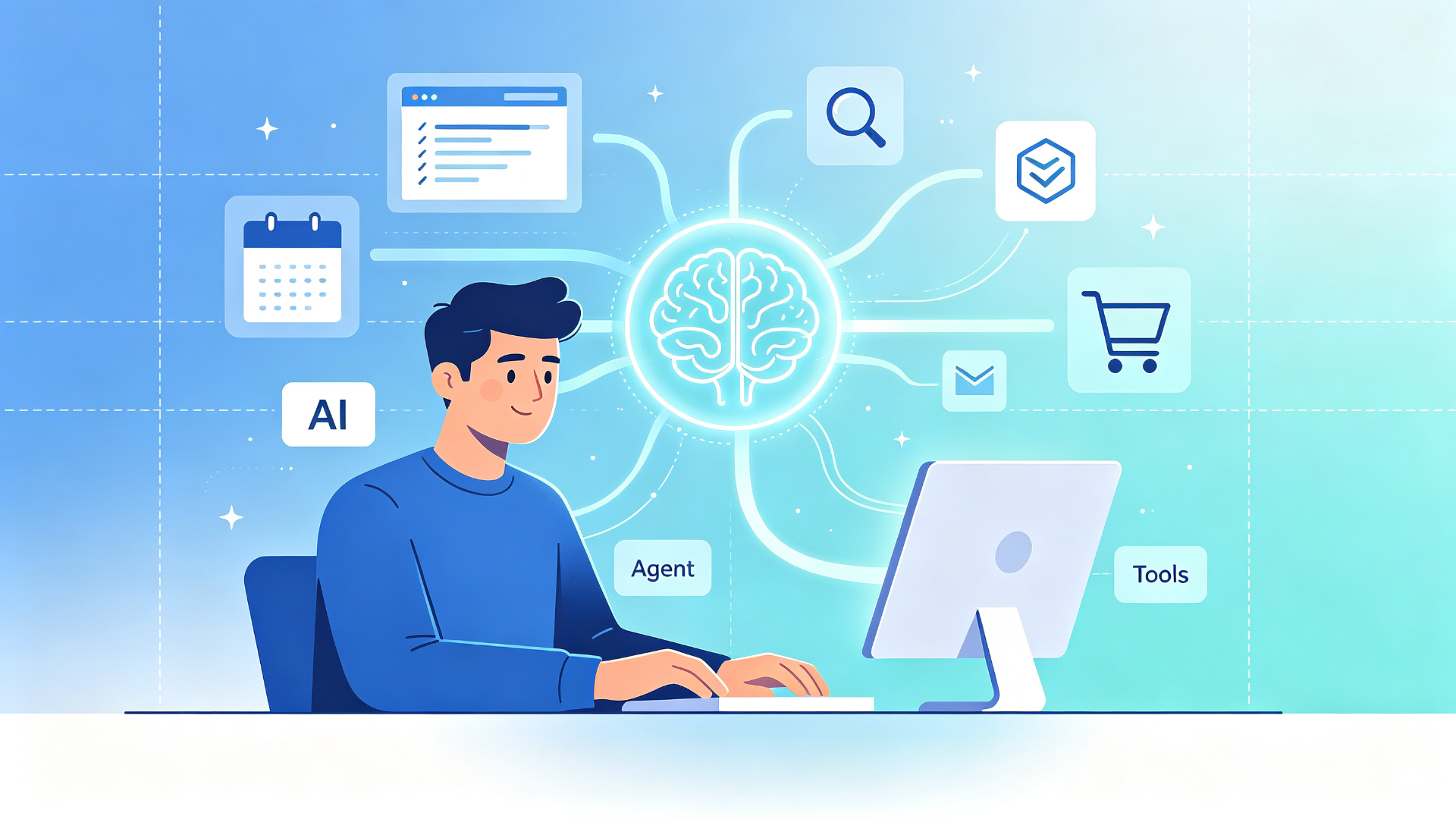
In the past two years, the hottest keyword in AI has shifted from "large language models" to "AI agents (AI Agent)". Previously, we asked AI "what is quantum mechanics" and it gave us an answer — that was it. Now, AI can "get things done for us" — automatically researching information, writing code, booking trips, and building spreadsheets, with multi-step operations that do not even require human supervision. Gartner noted in its 2025 Hype Cycle for Artificial Intelligence that AI agents were one of the two fastest-developing AI technologies that yearGartner Hype Cycle 2025. And RunningHub is precisely the product that turns this agent capability into something ordinary people can use with zero barriers — it aggregates 8,000+ model versions and 100,000+ workflows; with just one sentence, an AI agent will help you complete content creation such as images, videos, and short dramas. This guide uses a single article to explain the basic definition, core capabilities, and operating logic of AI agents, and introduces you to RunningHub, the "content creation platform natively driven by AI agents".
What Is an AI Agent?
A Simple Definition
An AI agent can be understood as an AI program that "has goals, can act, and can reflect". In its official guide A Practical Guide to Building Agents, OpenAI defines an agent as: a system that completes tasks independently on behalf of users, uses large language models (LLMs) to manage the execution process and make decisions, and interacts with external systems by calling tools. Tsinghua University Press's Introduction to AI Agents breaks it down further: an AI agent is a program driven by a large model and composed of components such as Planning, Memory, Tools, and Action, capable of autonomously executing tasks.
In simple terms: the large model is the "brain", while the AI agent is a complete executor of "brain + hands and feet + workbench" — it can not only think, but also get things done.
On RunningHub, this "brain + hands and feet + workbench" setup has been packaged into ready-to-use AI applications and ComfyUI workflows: you do not need to write code or configure an environment — just open your browser and command the agent to work for you.
Development Background: From "Talking the Talk" to "Getting Things Done"
After ChatGPT launched in late 2022, large models demonstrated powerful language understanding and generation capabilities, but the way they were used was basically "you ask, it answers". From 2023 onward, the industry began to "give large models hands and feet": letting them search the web, call calculators, execute code, and operate software. By 2024–2025, AI agents entered an explosive growth phase. Several key figures are worth noting:
- Gartner listed Agentic AI among its Top 10 Strategic Technology Trends for 2025, believing that AI agents are moving from "experimental exploration" toward "mainstream enterprise technology".
- Gartner predicts that by 2028, 33% of enterprise software applications will have agentic AI built in (this figure was less than 1% in 2024); at least 15% of daily work decisions will be made autonomously by agentic AI (this figure was 0% in 2024).
- Gartner predicts that by 2026, 40% of enterprise applications will feature task-specific AI agents (up from less than 5% in 2025).
- Market research firm MarketsandMarkets estimates that the global AI agent market will grow from $7.84 billion in 2025 to $52.62 billion in 2030, a compound annual growth rate (CAGR) of 46.3%.
- This trend is equally clear on the product side: RunningHub positions itself as a "content creation platform natively driven by AI agents", combining large models, tools, and workflows into reusable AI applicationsRunningHub official site, so that everyone can "command" agents to create.
Remember the core difference in one sentence: An ordinary large model is a "conversation expert" — you ask, it answers, and it stops there; an AI agent is a "task expert" — you give it a goal, and it breaks down the task, calls tools, executes, and delivers the result on its own.
AI Agents vs. Ordinary LLMs: Understanding at a Glance
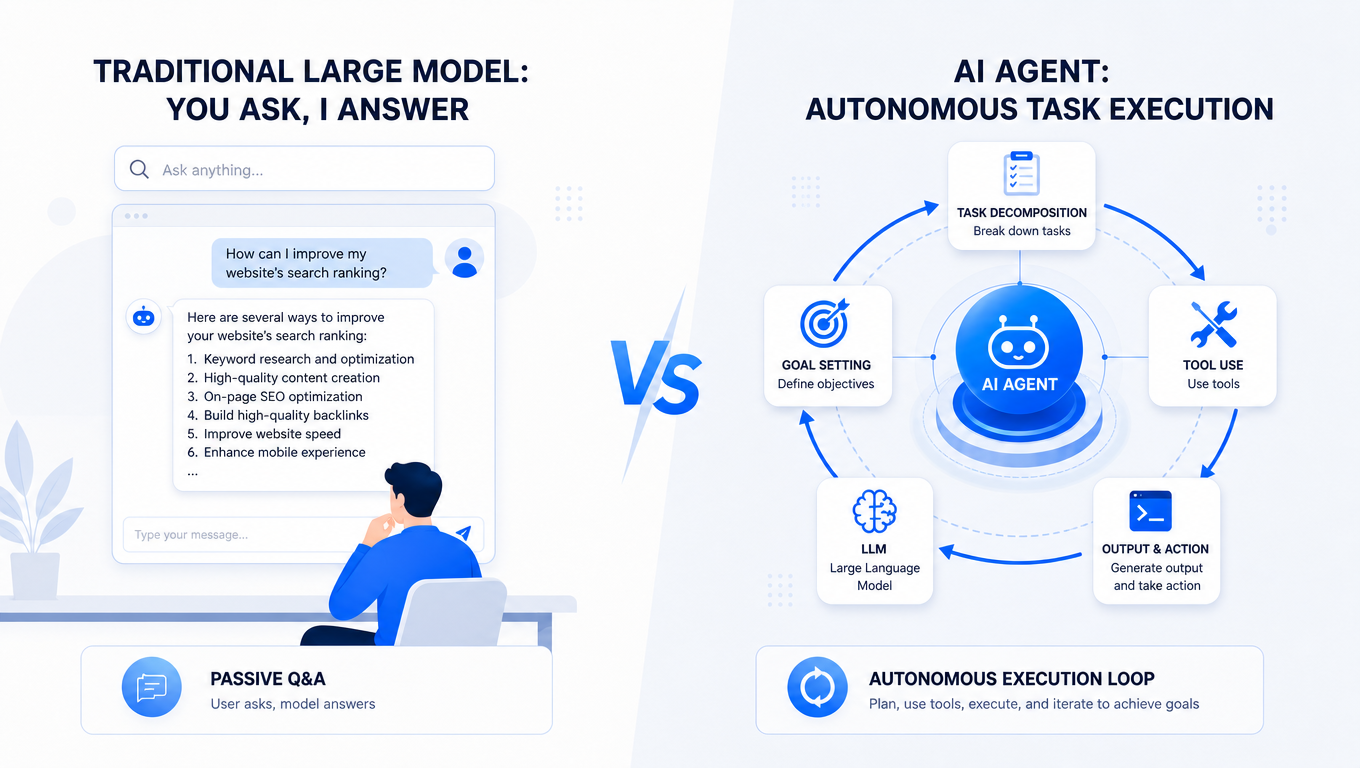
The essential difference lies in "whether the system has goal-oriented closed-loop action capability". The official engineering blog of Anthropic, Building Effective Agents, provides a more precise distinction: a system in which LLMs and tools are orchestrated through pre-written code paths is called a workflow; a system in which the LLM autonomously decides its own process and tool usage is an agent. Agents suit tasks with open-ended processes that require dynamic decision-making.
This is equally intuitive at the product level: an ordinary model API is just a "Q&A interface", while RunningHub's Quick Creation packages the complete "plan — execute — produce" loop into a service — you only need to enter one sentence, and the Agent automatically handles model selection, parameter tuning, and result generation.
| Dimension | Ordinary LLM | AI Agent |
| Interaction | Single/multi-turn Q&A, passive response | Executes autonomously after receiving a goal, actively advances |
| External tools | Usually does not call tools, only generates text | Can call tools such as search, code, APIs, and software |
| Memory | Limited to conversation context | Short-term memory + long-term memory (knowledge base) |
| Complex tasks | Can only give suggestions, cannot execute | Autonomously decomposes, executes step by step, adjusts dynamically |
| Self-reflection | None | Observes results, corrects and iterates |
| Typical output | Text answers | Completed task results (reports, code, orders, etc.) |
Core Capabilities of AI Agents
Autonomous Planning
Breaking a large goal into executable small steps and deciding what to do first and what to do next. For example, given "help me plan a tech salon", the agent will decompose it into: set the theme → find a venue → draft an agenda → design a poster → send invitations, then proceed item by item.
Memory System
Short-term memory records the context of the current task (conversation history, intermediate results); long-term memory stores historical experience and knowledge bases, allowing the agent to "understand you better the more you use it" and stay consistent across sessions.
Tool Use
Connecting external capabilities such as search engines, calculators, code interpreters, databases, and office software through APIs (interfaces), turning "knowing" into "doing". Tool calling / function calling is the key capability that distinguishes agents from ordinary chatbots.
On RunningHub, this "tool layer" is the platform's built-in ComfyUI workflow ecosystem: hundreds of tool nodes — such as video super-resolution, image enhancement, motion imitation, and virtual try-on — combine freely like LEGO bricks, giving agents real ability to "get things done".
Self-Reflection
After execution, the agent checks the results and, if something is wrong, adjusts its strategy and retries. OpenAI points out that agents can recognize whether a task is complete and proactively correct their own actions when necessary; on failure, they can also pause execution and hand control back to the user.
Multi-Agent Collaboration
Multiple specialized agents divide and collaborate: one handles planning, one handles execution, and one handles quality inspection, working together to complete complex tasks. Gartner calls this form "multi-agent generative systems (MAGS)", believing that it solves complex cross-functional problems through a "divide and conquer" approach.
On RunningHub, multi-agent collaboration is already productized: VibeX generates deployable tools from natural language, and AI Apps are packaged agent products that turn complex collaboration workflows into one-click runs.

How AI Agents Work: The Operating Logic
A Loop, Not a One-off Q&A
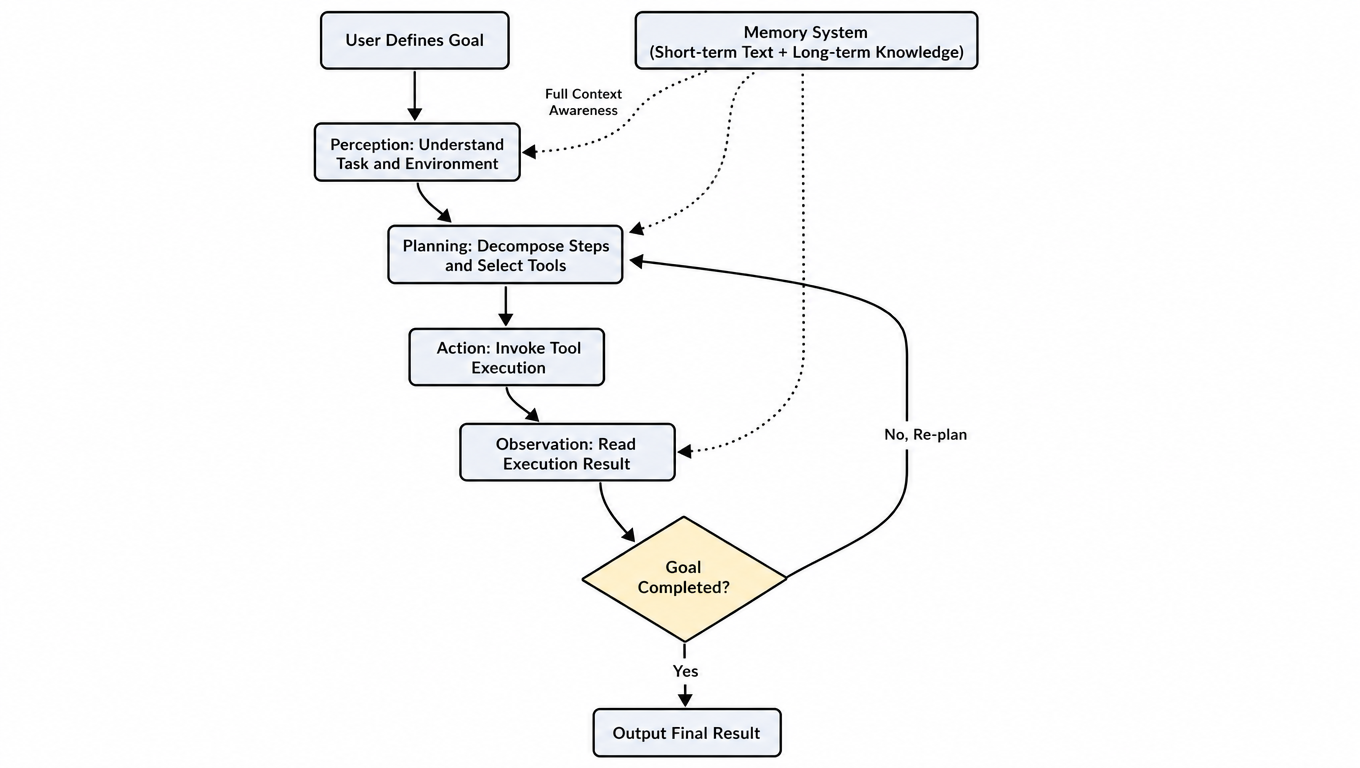
Anthropic summarizes the core operating pattern of agents as the "agentic loop": gather context → take action → verify results → repeat, until the task is complete. The loop is usually accomplished by four parts working together:
A Concrete Example: "Help Me Check Tomorrow's Weather and Give Travel Advice"
- Perceive: Parse the goal and identify two subtasks: "weather query" and "travel advice".
- Plan: Decide to first query data via the weather API, then generate advice based on the results.
- Act: Call the weather tool to get tomorrow's temperature, precipitation, wind, and other data for Beijing.
- Observe and reflect: Realize that a judgment on "whether outdoor activities are suitable" is still missing, and additionally call dressing-index and air-quality tools.
- Complete: Integrate the information and output a full answer including dressing advice and travel options.
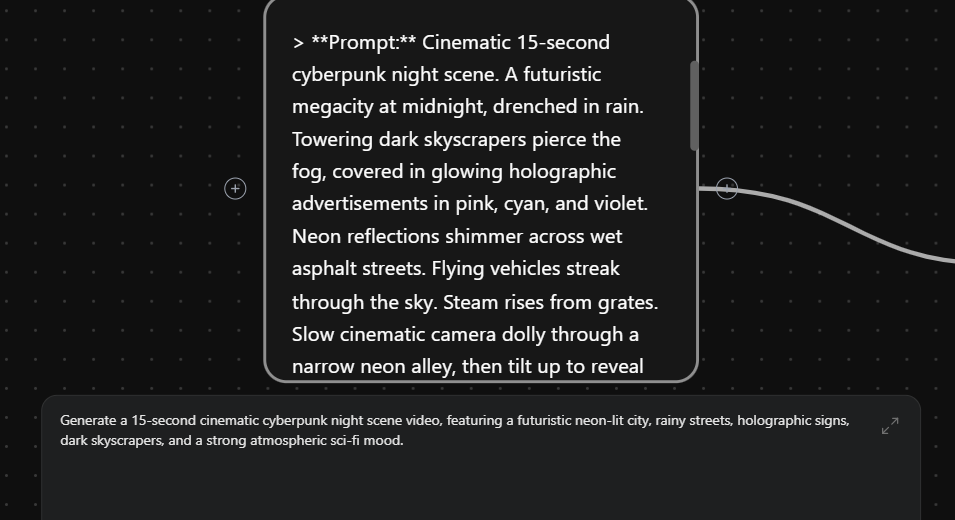
- The same closed loop happens on RunningHub every day: in "Quick Creation", enter "generate a 15-second cyberpunk city night-view video", and the Agent will automatically plan (select a text-to-video model) → act (call the model to generate) → observe (check the visual result) → return to planning when necessary (switch models or adjust parameters and retry), finally delivering a finished video — without any manual parameter configuration throughout.
AI Agents in the Real World

Today, AI agents have already penetrated daily work and life:
- Customer service and after-sales: Automatically understand user questions, look up orders, and handle returns and exchanges, escalating complex issues to human agents.
- Software development: Coding agents like Claude Code, Devin, and GitHub Copilot can read codebases, write code, run tests, and fix errors.
- Data analysis: Automatically clean data, generate charts, and write analysis reports.
- Office automation: Automatically organize emails, schedule appointments, summarize meeting minutes, and draft documents.
- Personal assistants: General-purpose agents launched by companies like Manus and Doubao automatically execute multi-step tasks once the user provides a goal.
Why Experience AI Agents on RunningHub?
The concept of AI agents is powerful, but building them yourself often requires programming skills, GPU compute, and tedious environment configuration. RunningHub moves all of this to the cloud, letting you focus on creation itself.
Cloud ComfyUI: Zero Deployment, Ready Out of the Box
No software installation, no Python environment configuration, no model weight downloads — just open your browser and log in to RunningHub to directly use all kinds of models and workflows on the cloud canvas. The platform comes pre-installed with the latest and most complete set of ComfyUI nodes, completely eliminating the headache of "missing nodes turning red".
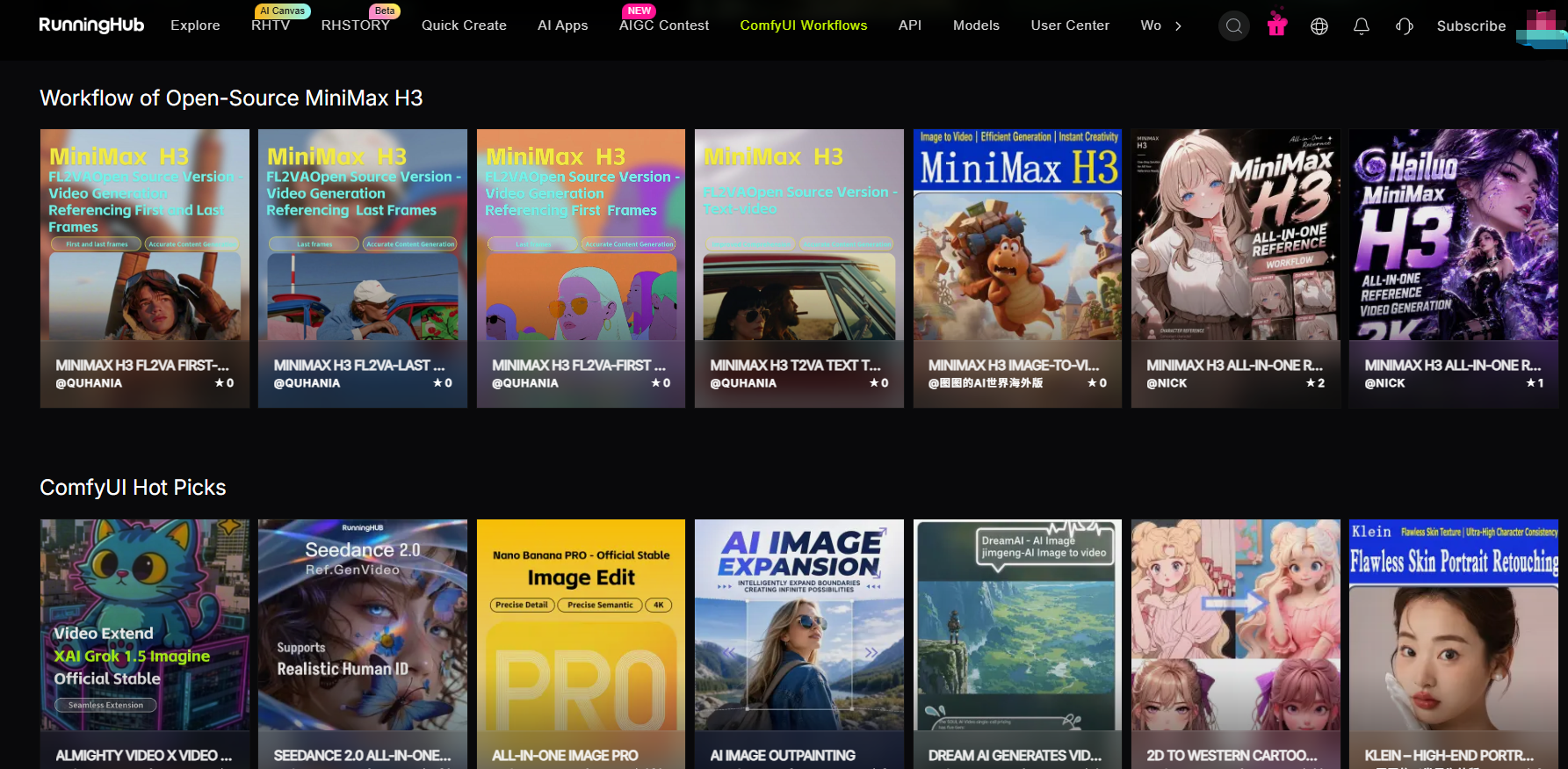
8,000+ Model Versions, 100,000+ Workflows
RunningHub aggregates 8,000+ model versions and 100,000+ community workflows, covering all-modality creation such as images, video, short dramas, comic dramas, and agents. Popular models (such as Seedance 2.5 and the Qwen image series) are ready to use with a quick search, and the vast template library contributed by the community can be reused with one click.
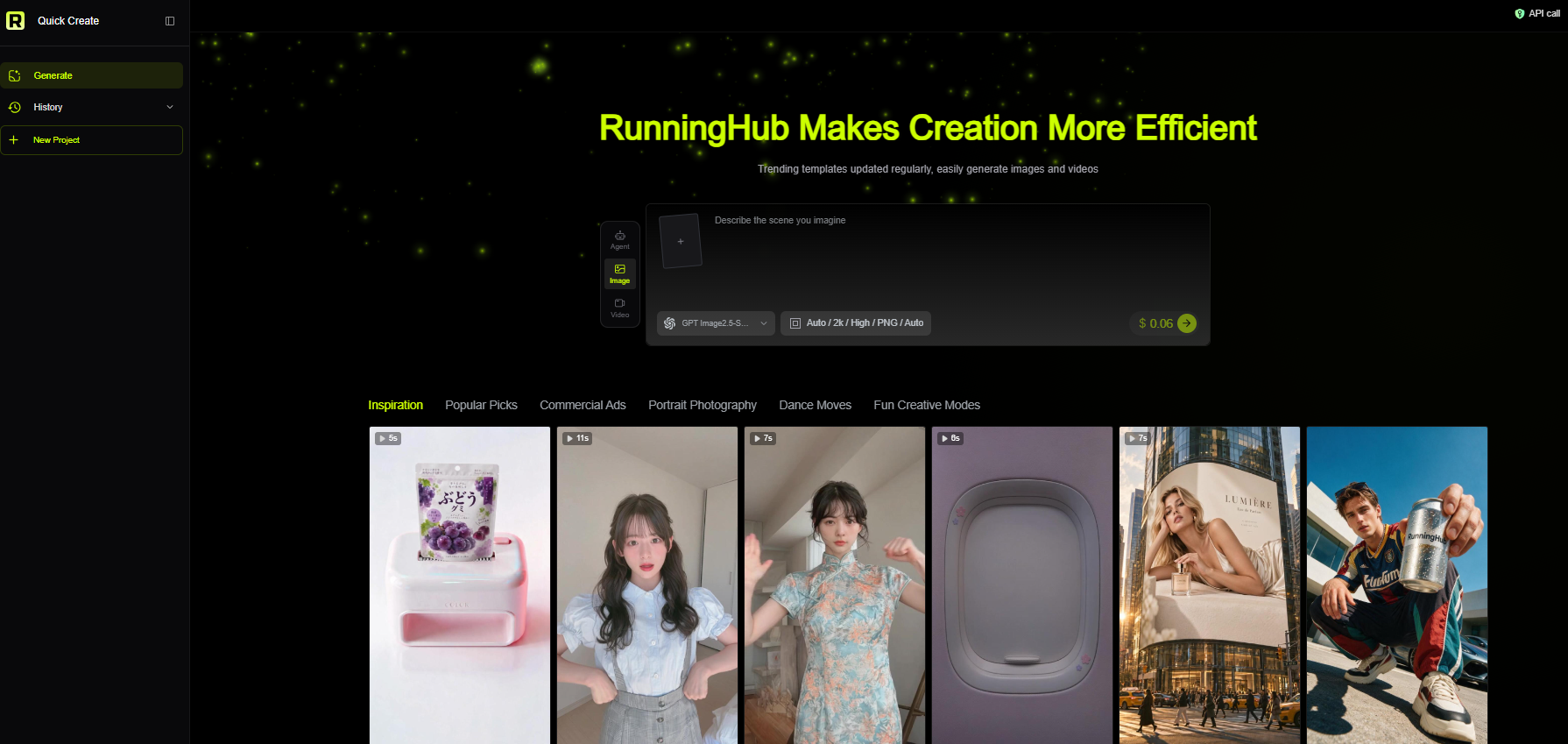
Quick Creation: One Sentence, and the Agent Generates Images and Videos for You
This is the concentrated embodiment of RunningHub's agent capabilities: enter a one-sentence description in "Quick Creation", and the Agent automatically completes model selection, parameter settings, and result generation, producing images, videos, and short dramas end to end — truly realizing "from idea to finished product".
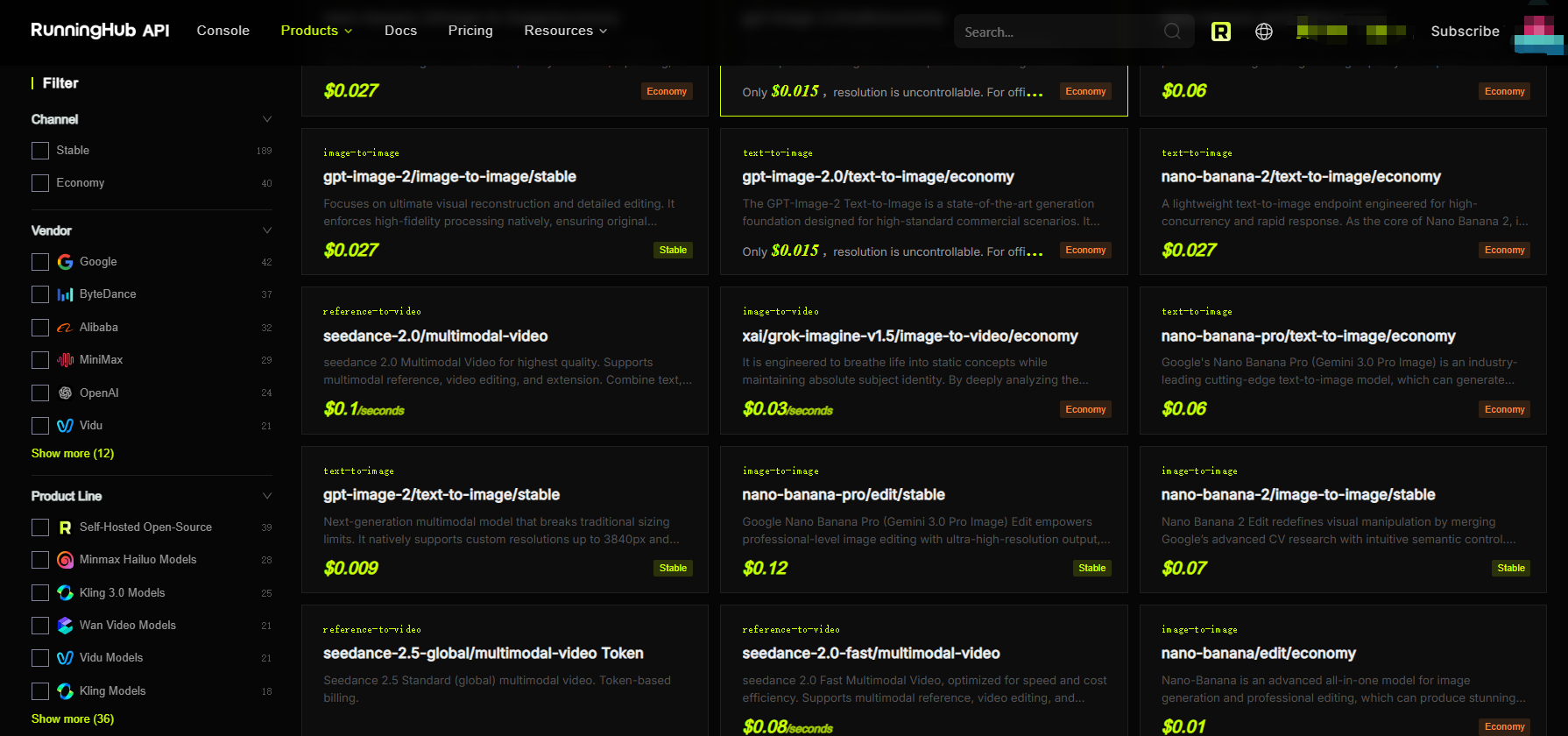
Model APIs and AI Apps: From Experience to Production
For developers and teams, RunningHub provides the All-Modal API — a single interface aggregating hundreds of large models, supporting all-modality generation including image, video, and audio, with pay-as-you-go pricing and no server idle costs; it also provides packaged AI Apps and the VibeX tool, so that agent workflows can be embedded directly into your business.
Try it now: visit the https://www.runninghub.ai/ to register an account and claim free RH coins to experience agent creation; invite friends to register and both of you get 500 RH coins each — the more you use it, the better the deal.
Get Started with AI Agents in Three Steps
- Open RunningHub: Visit https://www.runninghub.ai/ to register an account and claim the newcomer RH coins (invite friends to register and both sides get 500 RH coins each).
- Give a goal, not steps: In "RHTV", describe the result in one sentence, for example, "generate a 15-second cyberpunk night-view video", and let the Agent plan its own path.

Verify and iterate: Check the generated result; if you are not satisfied, have the Agent keep adjusting — switch styles, models, or parameters until you are happy; for important tasks, it is still recommended to keep a human confirmation step.
Summary
AI agent = large model (brain) + planning + memory + tools + an action loop. It advances AI from "being able to talk" to "being able to do", and is becoming a standard feature of enterprise software and personal tools. Understanding its definition, core capabilities, and operating logic is the first step to mastering the next generation of AI. If you want to experience "one sentence that makes AI work for you" firsthand, visit RunningHub now — zero deployment, zero barriers, claim RH coins upon registration, and let the agent generate your first image and your first video.
Sources and Further Reading
- Lil’Log (Lilian Weng), "LLM Powered Autonomous Agents" — a classic deep dive into planning, memory, and tool use
- LangChain Blog, "What is an AI agent?" — the definition of an agent as an LLM deciding application control flow
- Hugging Face Blog, "License to Call: Introducing Transformers Agents 2.0" — agents as LLM + tools, with hands-on ReAct loops
- DeepLearning.AI The Batch (Andrew Ng), "AI Agentic Workflows Could Drive More AI Progress Than Even the Next Generation of Foundation Models" — the four design patterns of reflection, tool use, planning, and multi-agent
- NVIDIA Blog, "What Is Agentic AI?" — the agent loop of perceive, reason, act, and learn
- IBM Think, "What Are AI Agents?" — agent definition and enterprise adoption
- Microsoft Blog, "Microsoft Build 2025: The age of AI agents and building the open agentic web" — the enterprise agent ecosystem and the open agentic web
- Simon Willison’s Weblog, "The lethal trifecta for AI agents" — agent data security and prompt injection risks