
'%3e %3cg id='Vector'%3e %3c/g%3e %3cpath id='Vector_2' d='M14.504 8.522L12.746 4.49C12.6826 4.34486 12.5783 4.22136 12.4458 4.13463C12.3133 4.0479 12.1584 4.0017 12 4.0017C11.8416 4.0017 11.6867 4.0479 11.5542 4.13463C11.4217 4.22136 11.3174 4.34486 11.254 4.49L9.495 8.522C9.305 8.958 8.958 9.306 8.522 9.495L4.49 11.254C4.34486 11.3174 4.22136 11.4217 4.13463 11.5542C4.0479 11.6867 4.0017 11.8416 4.0017 12C4.0017 12.1584 4.0479 12.3133 4.13463 12.4458C4.22136 12.5783 4.34486 12.6826 4.49 12.746L8.523 14.504C8.959 14.694 9.307 15.042 9.496 15.478L11.255 19.511C11.3184 19.6561 11.4227 19.7796 11.5552 19.8664C11.6877 19.9531 11.8426 19.9993 12.001 19.9993C12.1594 19.9993 12.3143 19.9531 12.4468 19.8664C12.5793 19.7796 12.6836 19.6561 12.747 19.511L14.505 15.478C14.695 15.042 15.043 14.694 15.479 14.504L19.512 12.746C19.6571 12.6826 19.7806 12.5783 19.8674 12.4458C19.9541 12.3133 20.0003 12.1584 20.0003 12C20.0003 11.8416 19.9541 11.6867 19.8674 11.5542C19.7806 11.4217 19.6571 11.3174 19.512 11.254L15.479 9.495C15.043 9.30549 14.695 8.95782 14.505 8.522' stroke='var(--stroke-0%2c white)' stroke-width='1.25' stroke-linecap='round' stroke-linejoin='round'/%3e %3cpath id='Vector_3' d='M3 3L5 5' stroke='var(--stroke-0%2c white)' stroke-width='1.25' stroke-linecap='round' stroke-linejoin='round'/%3e %3cpath id='Vector_4' d='M21 3L19 5' stroke='var(--stroke-0%2c white)' stroke-width='1.25' stroke-linecap='round' stroke-linejoin='round'/%3e %3cpath id='Vector_5' d='M3 21L5 19' stroke='var(--stroke-0%2c white)' stroke-width='1.25' stroke-linecap='round' stroke-linejoin='round'/%3e %3cpath id='Vector_6' d='M21 21L19 19' stroke='var(--stroke-0%2c white)' stroke-width='1.25' stroke-linecap='round' stroke-linejoin='round'/%3e %3c/g%3e %3cdefs%3e %3cclipPath id='clip0_0_55'%3e %3crect width='24' height='24' fill='white'/%3e %3c/clipPath%3e %3c/defs%3e %3c/svg%3e)
'%3e %3cg id='Vector'%3e %3c/g%3e %3cpath id='Vector_2' d='M14.375 7.66667H14.385' stroke='var(--stroke-0%2c white)' stroke-width='1.25' stroke-linecap='round' stroke-linejoin='round'/%3e %3cpath id='Vector_3' d='M11.9792 20.125H5.75C4.9875 20.125 4.25624 19.8221 3.71707 19.2829C3.1779 18.7438 2.875 18.0125 2.875 17.25V5.75C2.875 4.9875 3.1779 4.25624 3.71707 3.71707C4.25624 3.1779 4.9875 2.875 5.75 2.875H17.25C18.0125 2.875 18.7438 3.1779 19.2829 3.71707C19.8221 4.25624 20.125 4.9875 20.125 5.75V11.9792' stroke='var(--stroke-0%2c white)' stroke-width='1.25' stroke-linecap='round' stroke-linejoin='round'/%3e %3cpath id='Vector_4' d='M2.875 15.3333L7.66667 10.5417C8.556 9.68587 9.65233 9.68587 10.5417 10.5417L14.375 14.375' stroke='var(--stroke-0%2c white)' stroke-width='1.25' stroke-linecap='round' stroke-linejoin='round'/%3e %3cpath id='Vector_5' d='M13.4167 13.4167L14.375 12.4583C15.0171 11.8412 15.7646 11.6687 16.4661 11.9408' stroke='var(--stroke-0%2c white)' stroke-width='1.25' stroke-linecap='round' stroke-linejoin='round'/%3e %3cpath id='Vector_6' d='M15.3333 18.2083H21.0833' stroke='var(--stroke-0%2c white)' stroke-width='1.25' stroke-linecap='round' stroke-linejoin='round'/%3e %3cpath id='Vector_7' d='M18.2083 15.3333V21.0833' stroke='var(--stroke-0%2c white)' stroke-width='1.25' stroke-linecap='round' stroke-linejoin='round'/%3e %3c/g%3e %3cdefs%3e %3cclipPath id='clip0_0_4'%3e %3crect width='23' height='23' fill='white'/%3e %3c/clipPath%3e %3c/defs%3e %3c/svg%3e)


'%3e %3cg id='Vector'%3e %3c/g%3e %3cpath id='Vector_2' d='M18.3333 10.5001V6.66667C18.3333 5.78261 17.9821 4.93477 17.357 4.30964C16.7319 3.68452 15.8841 3.33333 15 3.33333H5C4.11594 3.33333 3.2681 3.68452 2.64298 4.30964C2.01786 4.93477 1.66667 5.78261 1.66667 6.66667V13.3333C1.66667 14.2174 2.01786 15.0652 2.64298 15.6904C3.2681 16.3155 4.11594 16.6667 5 16.6667H11.6667M15.5 17.0001V12.0001M13 14.5001L15.5 12.0001L18 14.5001' stroke='var(--stroke-0%2c white)' stroke-linecap='round' stroke-linejoin='round'/%3e %3cpath id='Vector_3' d='M8.33333 7.5L12.5 10L8.33333 12.5V7.5Z' stroke='var(--stroke-0%2c white)' stroke-linecap='round' stroke-linejoin='round'/%3e %3c/g%3e %3cdefs%3e %3cclipPath id='clip0_0_4'%3e %3crect width='20' height='20' fill='white'/%3e %3c/clipPath%3e %3c/defs%3e %3c/svg%3e)
'%3e %3cg id='Vector'%3e %3c/g%3e %3cpath id='Vector_2' d='M16.25 10.8333L21.1824 8.36767C21.3475 8.28515 21.531 8.2462 21.7154 8.25451C21.8998 8.26281 22.079 8.3181 22.2361 8.41512C22.3931 8.51214 22.5228 8.64768 22.6127 8.80888C22.7026 8.97007 22.7499 9.15158 22.75 9.33617V16.6638C22.7499 16.8484 22.7026 17.0299 22.6127 17.1911C22.5228 17.3523 22.3931 17.4879 22.2361 17.5849C22.079 17.6819 21.8998 17.7372 21.7154 17.7455C21.531 17.7538 21.3475 17.7148 21.1824 17.6323L16.25 15.1667V10.8333Z' stroke='var(--stroke-0%2c white)' stroke-width='1.25' stroke-linecap='round' stroke-linejoin='round'/%3e %3cpath id='Vector_3' d='M3.25 8.66667C3.25 8.09203 3.47827 7.54093 3.8846 7.1346C4.29093 6.72827 4.84203 6.5 5.41667 6.5H14.0833C14.658 6.5 15.2091 6.72827 15.6154 7.1346C16.0217 7.54093 16.25 8.09203 16.25 8.66667V17.3333C16.25 17.908 16.0217 18.4591 15.6154 18.8654C15.2091 19.2717 14.658 19.5 14.0833 19.5H5.41667C4.84203 19.5 4.29093 19.2717 3.8846 18.8654C3.47827 18.4591 3.25 17.908 3.25 17.3333V8.66667Z' stroke='var(--stroke-0%2c white)' stroke-width='1.25' stroke-linecap='round' stroke-linejoin='round'/%3e %3cpath id='Vector_4' d='M7.58333 13H11.9167' stroke='var(--stroke-0%2c white)' stroke-width='1.25' stroke-linecap='round' stroke-linejoin='round'/%3e %3cpath id='Vector_5' d='M9.75 10.8333V15.1667' stroke='var(--stroke-0%2c white)' stroke-width='1.25' stroke-linecap='round' stroke-linejoin='round'/%3e %3c/g%3e %3cdefs%3e %3cclipPath id='clip0_0_47'%3e %3crect width='26' height='26' fill='white'/%3e %3c/clipPath%3e %3c/defs%3e %3c/svg%3e)
'%3e %3cg id='Vector'%3e %3c/g%3e %3cpath id='Vector_2' d='M4 7H7M11 7H20' stroke='var(--stroke-0%2c white)' stroke-width='1.25' stroke-linecap='round' stroke-linejoin='round'/%3e %3cpath id='Vector_3' d='M4 17H20' stroke='var(--stroke-0%2c white)' stroke-width='1.25' stroke-linecap='round' stroke-linejoin='round'/%3e %3cpath id='Vector_4' d='M7 4L7 20' stroke='var(--stroke-0%2c white)' stroke-width='1.25' stroke-linecap='round' stroke-linejoin='round'/%3e %3cpath id='Vector_5' d='M17 4V13M17 17V20' stroke='var(--stroke-0%2c white)' stroke-width='1.25' stroke-linecap='round' stroke-linejoin='round'/%3e %3c/g%3e %3cdefs%3e %3cclipPath id='clip0_0_60'%3e %3crect width='24' height='24' fill='white'/%3e %3c/clipPath%3e %3c/defs%3e %3c/svg%3e)
'%3e %3cg id='Vector'%3e %3c/g%3e %3cpath id='Vector_2' d='M6 10L4 11L12 15L20 11L18 10' stroke='var(--stroke-0%2c white)' stroke-width='1.25' stroke-linecap='round' stroke-linejoin='round'/%3e %3cpath id='Vector_3' d='M4 15L12 19L20 15' stroke='var(--stroke-0%2c white)' stroke-width='1.25' stroke-linecap='round' stroke-linejoin='round'/%3e %3cpath id='Vector_4' d='M12 4V11' stroke='var(--stroke-0%2c white)' stroke-width='1.25' stroke-linecap='round' stroke-linejoin='round'/%3e %3cpath id='Vector_5' d='M15 8L12 11L9 8' stroke='var(--stroke-0%2c white)' stroke-width='1.25' stroke-linecap='round' stroke-linejoin='round'/%3e %3c/g%3e %3cdefs%3e %3cclipPath id='clip0_0_9'%3e %3crect width='24' height='24' fill='white'/%3e %3c/clipPath%3e %3c/defs%3e %3c/svg%3e)


Fastest LLMs in 2026: 10 AI Models Compared for Speed and Performance
Explore 10 fast LLMs in 2026. Compare inference speed, latency, context windows, API access, and pricing, and learn how to use supported models through RunningHub
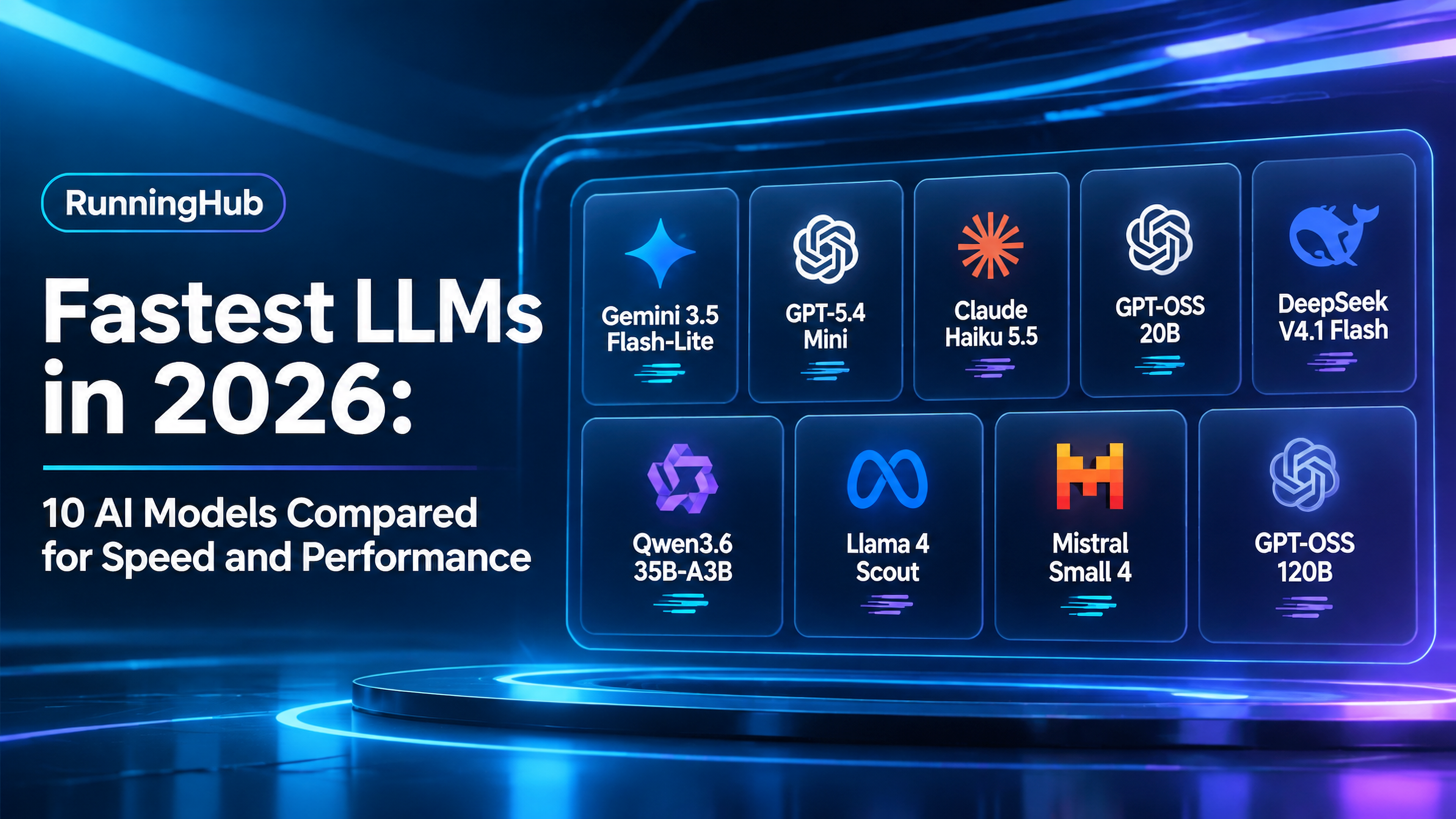
Speed is becoming one of the most important factors in choosing a large language model. Whether you are developing an AI chatbot, coding assistant, or automated business application, slow responses can negatively affect user experience and productivity.
However, finding the fastest LLM requires more than comparing advertised tokens per second. Response latency, inference throughput, model quality, context length, and API costs all influence real-world performance.
In this guide, we explore 10 notable fast AI models and inference options, including GPT, Gemini, Claude, DeepSeek, Qwen, Llama, and Mistral.
We also introduce RunningHub, an AI platform that provides supported language model APIs alongside image generation, video creation, AI applications, and customizable workflows.
What Makes an LLM Fast? Understanding Key Performance Metrics
Choosing the fastest AI model requires understanding how inference performance is measured.
Time to First Token (TTFT)
TTFT measures the time between sending a request and receiving the first generated token.
Low TTFT helps chatbots, voice assistants, and other interactive systems feel responsive.
However, it does not indicate how long the complete answer will take.
Output Speed: Tokens per Second
Output speed describes how many tokens a model generates per second after generation begins.
It matters for coding assistants, document generation, and applications producing lengthy responses.
Because tokenization differs across models, published token rates should be compared carefully.
Throughput and Concurrency
Throughput measures how much work an inference system processes over time, while concurrency refers to simultaneous requests.
A model that performs well with one request may behave differently under heavy traffic.
Context length, prompt size, hardware, inference infrastructure, and reasoning settings can also affect performance.
Why Isn't There One Universal Fastest AI Model?
Inference performance depends on multiple variables.
A model may offer excellent output generation speed but take longer to produce the first token. Another may respond quickly to short prompts but slow down with lengthy context.
Deployment hardware, concurrency, geographic region, caching, and reasoning behavior also influence performance.
For this reason, the best LLM is not necessarily the one with the highest advertised tokens-per-second figure.
Developers should compare performance using representative tasks and consistent testing conditions.
Fastest LLMs: 10 AI Models and Inference Options Compared
The following models are selected for their efficient architecture, low-latency positioning, or availability through performance-focused inference providers.
Important: The order represents an editorial selection, not a verified ranking by output speed.
1. RunningHub – Best for Multi-Model AI Access and Creative Workflows
Platform: RunningHub
Category: AI Model and API Platform
RunningHub is a cloud-based AI creation and development platform that provides access to supported language models, multimodal AI capabilities, and customizable creative workflows.
Unlike individual LLM providers, RunningHub combines language model APIs with image generation, video creation, AI Apps, and ComfyUI workflows within a broader development ecosystem.
Its LLM API supports compatible OpenAI, Anthropic, and Gemini protocol formats, allowing developers to integrate supported models into their applications.
Speed Performance: Depends on the selected model, API service, and workload. RunningHub does not have a single platform-wide tokens-per-second metric.
Key Advantages:
- Access to multiple supported AI models.
- LLM API and creative model API services.
- AI Apps and ComfyUI workflow integration.
- Flexible options for multimodal application development.
Limitations: Model availability, API requirements, and pricing vary by service. Direct LLM API access requires the appropriate Enterprise-Shared API Key.
Best For: Developers building AI assistants, multimodal applications, content-generation tools, and automated creative workflows.
2.Gemini 3.5 Flash-Lite – Best for Efficient Multimodal AI
Developer: Google
Gemini 3.5 Flash-Lite is part of Google's efficiency-oriented Gemini lineup.
It is suitable for applications that need responsive language processing alongside multimodal capabilities.
Google provides official API documentation describing model access, features, and pricing.
Key advantages: Multimodal functionality, scalable API access, and efficiency-focused positioning.
Limitations: Actual performance depends on prompt length, reasoning settings, and service conditions.
Best for: Translation, lightweight automation, multimodal assistants, and high-volume applications.
3. GPT-5.4 Mini – Best for General-Purpose AI Applications
Developer: OpenAI
GPT-5.4 Mini is designed for efficient deployment across coding, agentic applications, and other high-volume workloads.
It provides a smaller model alternative for developers who do not need to use a flagship model for every request.
Key advantages: Developer tooling, structured outputs, coding support, and established API integration.
Limitations: Output quality and latency depend on task complexity and reasoning configuration.
Best for: AI assistants, coding tools, and business automation.
4. Claude Haiku 5.5 – Best for Fast Language Processing
Developer: Anthropic
Claude Haiku 5.5 is positioned for efficient language processing and latency-sensitive workloads.
Its official documentation identifies support for long-context processing and configurable reasoning behavior.
It can be considered for tasks where developers need useful language capabilities without automatically selecting a larger Claude model.
Key advantages: Text processing, document understanding, and adjustable reasoning effort.
Limitations: Long prompts and reasoning settings can increase total response time and cost.
Best for: Customer support, information extraction, document processing, and task routing.
5. GPT-OSS 20B on Groq – Best for Accelerated Inference
Model developer: OpenAI
Inference provider: Groq
Groq serves OpenAI's GPT-OSS 20B model through optimized inference infrastructure.
Its official model catalog advertises approximately 1,000 tokens per second for the hosted model.
This number is a provider-published performance figure, not a standardized independent benchmark.
Groq also publishes the model's context specifications, API rates, and usage limits.
Key advantages: High advertised output speed, API accessibility, and published pricing.
Limitations: Actual production speed varies with request conditions and service limits.
Best for: Responsive chat applications and high-speed language processing.
6. DeepSeek V4.1 Flash – Best for Cost-Conscious Language Applications
Developer: DeepSeek
DeepSeek provides API access to its Flash model for language processing and development workflows.
Its official documentation describes the available API model identifiers and corresponding billing rules.
Developers seeking efficient LLM inference can evaluate DeepSeek alongside proprietary and open-weight alternatives.
Key advantages: API accessibility, coding-oriented use cases, and usage-based pricing.
Limitations: Performance depends on task difficulty, response length, and inference settings.
Best for: Coding assistance, summarization, and cost-sensitive AI applications.
7. Qwen3.6 35B-A3B – Best for Flexible Open-Weight Deployment
Developer: Alibaba
Qwen3.6 35B-A3B belongs to the Qwen family of open-weight language models.
Its mixture-of-experts architecture is designed to support efficient inference while maintaining capabilities for coding and general language tasks.
Different inference providers may offer different deployment configurations.
Key advantages: Open-weight deployment, model customization, and coding-oriented applications.
Limitations: Hardware and hosting configurations substantially affect actual performance.
Best for: Custom inference deployments, AI agents, and development workflows.
8. Llama 4 Scout – Best for Flexible Long-Context Applications
Developer: Meta
Example inference provider: Together AI
Llama 4 Scout is an open-weight model designed to support multimodal and long-context applications.
It provides an alternative for teams looking for greater control over hosting and deployment.
Together AI offers API access to supported Llama models.
Key advantages: Open-weight availability, multimodal processing, and deployment flexibility.
Limitations: Long-context inference can increase memory requirements and response time.
Best for: Knowledge retrieval, document analysis, and customized AI systems.
9. Mistral Small 4 – Best for Efficient General-Purpose Tasks
Developer: Mistral AI
Mistral Small 4 combines language understanding, instruction following, reasoning, and coding-related capabilities.
Its official model documentation confirms its place within Mistral's current model ecosystem.
The model is worth considering when deployment efficiency and a flexible set of language capabilities are important.
Key advantages: Efficient architecture, developer access, and versatile task support.
Limitations: More demanding tasks may benefit from larger models.
Best for: Document processing, automation, and general-purpose AI applications.
10. GPT-OSS 120B on Cerebras – Best for High-Speed Large-Model Inference
Model developer: OpenAI
Inference provider: Cerebras
Cerebras provides accelerated inference for OpenAI's GPT-OSS 120B model.
Its official pricing page advertises approximately 3,000 output tokens per second for this model.
This is a provider-published performance figure. It should not be treated as directly comparable to independent benchmarks or Groq's figures without matching test conditions.
Key advantages: Specialized inference infrastructure and high advertised generation speed.
Limitations: Deployment tier, prompt size, and traffic conditions influence real-world performance.
Best for: Agentic workflows, long-form generation, and high-speed AI applications.
Fastest AI Model Comparison: Features, Speed Evidence, and API Access
The table below intentionally avoids estimated latency and token-generation figures that could not be verified under comparable conditions.
| Model | Developer | Main Strength | Official Access |
| RunningHub | RunningHub | Multi-model AI access, LLM APIs, creative workflows | RunningHub API |
| Gemini 3.5 Flash-Lite | Efficient multimodal processing | Gemini API | |
| GPT-5.4 Mini | OpenAI | General-purpose AI | OpenAI API |
| Claude Haiku 5.5 | Anthropic | Language processing | Claude API |
| GPT-OSS 20B | OpenAI | Accelerated inference | Groq |
| DeepSeek V4.1 Flash | DeepSeek | Cost-conscious language tasks | DeepSeek API |
| Qwen3.6 35B-A3B | Alibaba | Open-weight deployment | Supported providers |
| Llama 4 Scout | Meta | Long-context applications | Together AI |
| Mistral Small 4 | Mistral | Efficient general-purpose tasks | Mistral API |
| GPT-OSS 120B | OpenAI | Accelerated large-model inference | Cerebras |
Which Fastest LLM Is Best for Your Application?
| Application | Main Priority | Models Worth Testing |
| Real-time chatbot | Low TTFT | Gemini Flash-Lite, Ministral 3 3B |
| Coding assistant | Speed and code quality | GPT-5.4 Mini, GPT-OSS 120B |
| Customer service | Stable response time | Claude Haiku 5.5, Gemini Flash-Lite |
| High-volume text processing | Throughput and cost | DeepSeek Flash, GPT-OSS 20B |
| Long-document analysis | Context handling | Llama 4 Scout, Claude Haiku |
| Lightweight automation | Resource efficiency | Ministral 3 3B, Mistral Small 4 |
| Customized deployment | Model and infrastructure control | Qwen, Llama, GPT-OSS |
Why Choose RunningHub LLM API?
1.Explore Multiple LLMs in One Place
Instead of researching every provider separately, developers can browse available models through RunningHub's LLM API catalog.
The catalog includes model information from providers such as OpenAI, Google, Anthropic, and DeepSeek, with availability depending on the current listings.
This makes it easier to explore different options for chatbots, coding assistants, and automated workflows.
2.Compare Models Based on Features and Costs
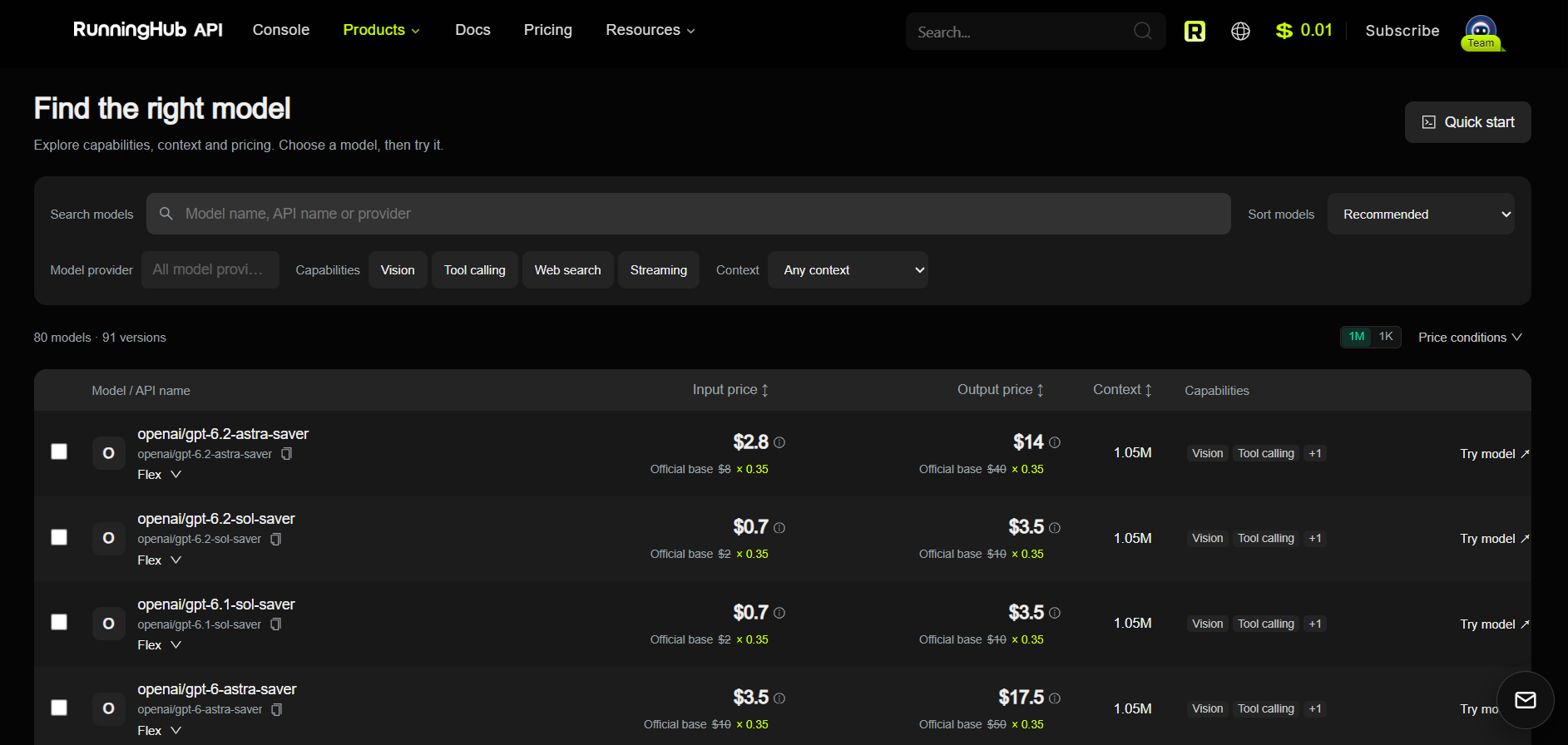
RunningHub's official model catalog displays supported capabilities, context information, and input/output pricing.
Developers can filter models by features such as vision, tool calling, and streaming where supported.
Rather than assuming one model is always the fastest, users can shortlist suitable models and test their performance on actual workloads.
3.Simplify API Integration
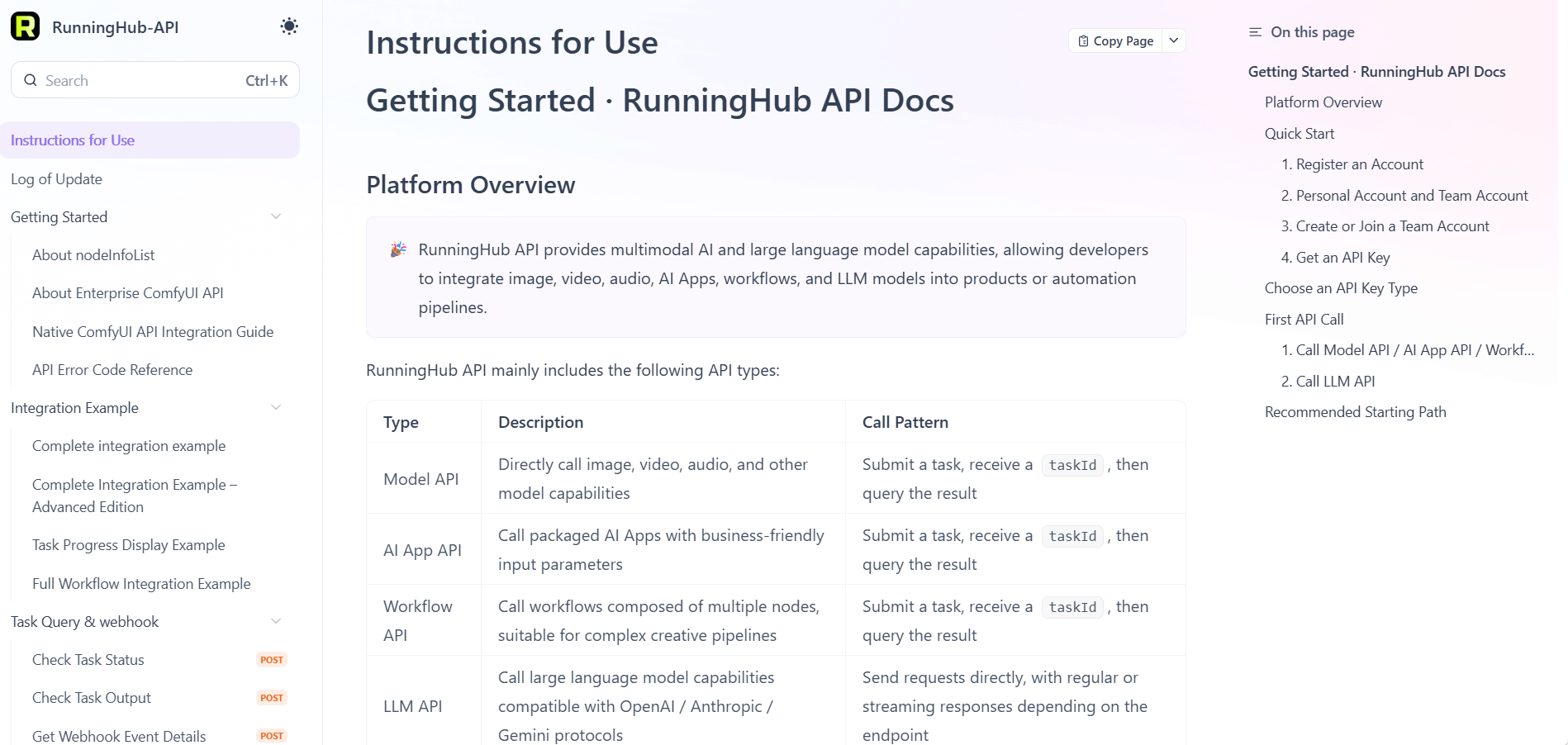
RunningHub's LLM API documentation describes compatibility with OpenAI, Anthropic, and Gemini protocol formats.
This can make integration more convenient for developers already familiar with these API structures, although model-specific compatibility and parameters should still be checked.
4.Build Beyond Text Generation
RunningHub also provides AI Apps, image and video generation services, and ComfyUI workflows.
This broader ecosystem is useful for developers building multimodal applications or automating creative production processes.
Speed Performance: Depends on the selected model, API configuration, and workload. RunningHub does not have a universal platform-wide inference speed.
Best For: Developers who want to explore supported LLMs, compare API options, and integrate language models alongside creative AI capabilities.
How to Access LLM APIs Through RunningHub
Step 1: Explore the LLM Model Catalog
Visit the RunningHub LLM Models page.
Browse the available providers and model listings. Review supported capabilities such as chat, tools, vision, and streaming, where available.
Step 2: Choose the Appropriate API Service
Select an LLM API for text-related applications or a suitable creative Model API for generation tasks.
Different API categories may have different inputs, outputs, and request workflows.
Step 3: Review Authentication and Documentation
According to the official documentation, RunningHub's LLM API is compatible with OpenAI, Anthropic, and Gemini protocol formats.
The platform specifies that direct LLM API and Model API access requires an Enterprise-Shared API Key.
Developers should review the relevant documentation before configuring authentication or request parameters.
Step 4: Test Your Application
After integration, evaluate request latency, generation time, response quality, and cost per successful request.
For LLM applications, measure time to first token and output generation speed. For image or video APIs, measure total task completion time instead.
RunningHub is particularly relevant when an application requires both language models and creative AI capabilities.
FAQ: Fastest LLMs and AI Model Performance
What Is the Fastest LLM Available?
There is no universal answer. The fastest model depends on whether speed refers to first-token latency, output speed, throughput, or complete response time.
Which Fastest LLM Is Best for Coding?
Models such as GPT-5.4 Mini and GPT-OSS 120B are worth evaluating. Coding accuracy, response latency, and task completion cost should be tested together.
Are Smaller LLMs Always Faster?
No. Smaller models generally require fewer computational resources, but specialized inference infrastructure can make larger models highly responsive.
How Do Latency and Throughput Differ?
Latency measures the response time of an individual request. Throughput measures how much work a system processes over time.
Can I Access Fast LLMs Through RunningHub?
RunningHub provides APIs for supported language models and other AI capabilities. Availability depends on the current model catalog and API configuration.
9. Final Verdict: Which Fastest LLM Should You Choose?
Choosing the fastest LLM involves balancing speed, quality, context, reliability, and cost.
Google, OpenAI, Anthropic, DeepSeek, Qwen, and Mistral provide different options for efficient language processing. Groq and Cerebras demonstrate how specialized inference infrastructure can accelerate supported open-weight models.
For projects combining language models with image generation, video creation, or reusable AI workflows, RunningHub offers a broader development environment.
Explore RunningHub to discover supported LLM APIs, AI models, and flexible creative workflows for your next project.