
'%3e %3cg id='Vector'%3e %3c/g%3e %3cpath id='Vector_2' d='M14.504 8.522L12.746 4.49C12.6826 4.34486 12.5783 4.22136 12.4458 4.13463C12.3133 4.0479 12.1584 4.0017 12 4.0017C11.8416 4.0017 11.6867 4.0479 11.5542 4.13463C11.4217 4.22136 11.3174 4.34486 11.254 4.49L9.495 8.522C9.305 8.958 8.958 9.306 8.522 9.495L4.49 11.254C4.34486 11.3174 4.22136 11.4217 4.13463 11.5542C4.0479 11.6867 4.0017 11.8416 4.0017 12C4.0017 12.1584 4.0479 12.3133 4.13463 12.4458C4.22136 12.5783 4.34486 12.6826 4.49 12.746L8.523 14.504C8.959 14.694 9.307 15.042 9.496 15.478L11.255 19.511C11.3184 19.6561 11.4227 19.7796 11.5552 19.8664C11.6877 19.9531 11.8426 19.9993 12.001 19.9993C12.1594 19.9993 12.3143 19.9531 12.4468 19.8664C12.5793 19.7796 12.6836 19.6561 12.747 19.511L14.505 15.478C14.695 15.042 15.043 14.694 15.479 14.504L19.512 12.746C19.6571 12.6826 19.7806 12.5783 19.8674 12.4458C19.9541 12.3133 20.0003 12.1584 20.0003 12C20.0003 11.8416 19.9541 11.6867 19.8674 11.5542C19.7806 11.4217 19.6571 11.3174 19.512 11.254L15.479 9.495C15.043 9.30549 14.695 8.95782 14.505 8.522' stroke='var(--stroke-0%2c white)' stroke-width='1.25' stroke-linecap='round' stroke-linejoin='round'/%3e %3cpath id='Vector_3' d='M3 3L5 5' stroke='var(--stroke-0%2c white)' stroke-width='1.25' stroke-linecap='round' stroke-linejoin='round'/%3e %3cpath id='Vector_4' d='M21 3L19 5' stroke='var(--stroke-0%2c white)' stroke-width='1.25' stroke-linecap='round' stroke-linejoin='round'/%3e %3cpath id='Vector_5' d='M3 21L5 19' stroke='var(--stroke-0%2c white)' stroke-width='1.25' stroke-linecap='round' stroke-linejoin='round'/%3e %3cpath id='Vector_6' d='M21 21L19 19' stroke='var(--stroke-0%2c white)' stroke-width='1.25' stroke-linecap='round' stroke-linejoin='round'/%3e %3c/g%3e %3cdefs%3e %3cclipPath id='clip0_0_55'%3e %3crect width='24' height='24' fill='white'/%3e %3c/clipPath%3e %3c/defs%3e %3c/svg%3e)
'%3e %3cg id='Vector'%3e %3c/g%3e %3cpath id='Vector_2' d='M14.375 7.66667H14.385' stroke='var(--stroke-0%2c white)' stroke-width='1.25' stroke-linecap='round' stroke-linejoin='round'/%3e %3cpath id='Vector_3' d='M11.9792 20.125H5.75C4.9875 20.125 4.25624 19.8221 3.71707 19.2829C3.1779 18.7438 2.875 18.0125 2.875 17.25V5.75C2.875 4.9875 3.1779 4.25624 3.71707 3.71707C4.25624 3.1779 4.9875 2.875 5.75 2.875H17.25C18.0125 2.875 18.7438 3.1779 19.2829 3.71707C19.8221 4.25624 20.125 4.9875 20.125 5.75V11.9792' stroke='var(--stroke-0%2c white)' stroke-width='1.25' stroke-linecap='round' stroke-linejoin='round'/%3e %3cpath id='Vector_4' d='M2.875 15.3333L7.66667 10.5417C8.556 9.68587 9.65233 9.68587 10.5417 10.5417L14.375 14.375' stroke='var(--stroke-0%2c white)' stroke-width='1.25' stroke-linecap='round' stroke-linejoin='round'/%3e %3cpath id='Vector_5' d='M13.4167 13.4167L14.375 12.4583C15.0171 11.8412 15.7646 11.6687 16.4661 11.9408' stroke='var(--stroke-0%2c white)' stroke-width='1.25' stroke-linecap='round' stroke-linejoin='round'/%3e %3cpath id='Vector_6' d='M15.3333 18.2083H21.0833' stroke='var(--stroke-0%2c white)' stroke-width='1.25' stroke-linecap='round' stroke-linejoin='round'/%3e %3cpath id='Vector_7' d='M18.2083 15.3333V21.0833' stroke='var(--stroke-0%2c white)' stroke-width='1.25' stroke-linecap='round' stroke-linejoin='round'/%3e %3c/g%3e %3cdefs%3e %3cclipPath id='clip0_0_4'%3e %3crect width='23' height='23' fill='white'/%3e %3c/clipPath%3e %3c/defs%3e %3c/svg%3e)


'%3e %3cg id='Vector'%3e %3c/g%3e %3cpath id='Vector_2' d='M18.3333 10.5001V6.66667C18.3333 5.78261 17.9821 4.93477 17.357 4.30964C16.7319 3.68452 15.8841 3.33333 15 3.33333H5C4.11594 3.33333 3.2681 3.68452 2.64298 4.30964C2.01786 4.93477 1.66667 5.78261 1.66667 6.66667V13.3333C1.66667 14.2174 2.01786 15.0652 2.64298 15.6904C3.2681 16.3155 4.11594 16.6667 5 16.6667H11.6667M15.5 17.0001V12.0001M13 14.5001L15.5 12.0001L18 14.5001' stroke='var(--stroke-0%2c white)' stroke-linecap='round' stroke-linejoin='round'/%3e %3cpath id='Vector_3' d='M8.33333 7.5L12.5 10L8.33333 12.5V7.5Z' stroke='var(--stroke-0%2c white)' stroke-linecap='round' stroke-linejoin='round'/%3e %3c/g%3e %3cdefs%3e %3cclipPath id='clip0_0_4'%3e %3crect width='20' height='20' fill='white'/%3e %3c/clipPath%3e %3c/defs%3e %3c/svg%3e)
'%3e %3cg id='Vector'%3e %3c/g%3e %3cpath id='Vector_2' d='M16.25 10.8333L21.1824 8.36767C21.3475 8.28515 21.531 8.2462 21.7154 8.25451C21.8998 8.26281 22.079 8.3181 22.2361 8.41512C22.3931 8.51214 22.5228 8.64768 22.6127 8.80888C22.7026 8.97007 22.7499 9.15158 22.75 9.33617V16.6638C22.7499 16.8484 22.7026 17.0299 22.6127 17.1911C22.5228 17.3523 22.3931 17.4879 22.2361 17.5849C22.079 17.6819 21.8998 17.7372 21.7154 17.7455C21.531 17.7538 21.3475 17.7148 21.1824 17.6323L16.25 15.1667V10.8333Z' stroke='var(--stroke-0%2c white)' stroke-width='1.25' stroke-linecap='round' stroke-linejoin='round'/%3e %3cpath id='Vector_3' d='M3.25 8.66667C3.25 8.09203 3.47827 7.54093 3.8846 7.1346C4.29093 6.72827 4.84203 6.5 5.41667 6.5H14.0833C14.658 6.5 15.2091 6.72827 15.6154 7.1346C16.0217 7.54093 16.25 8.09203 16.25 8.66667V17.3333C16.25 17.908 16.0217 18.4591 15.6154 18.8654C15.2091 19.2717 14.658 19.5 14.0833 19.5H5.41667C4.84203 19.5 4.29093 19.2717 3.8846 18.8654C3.47827 18.4591 3.25 17.908 3.25 17.3333V8.66667Z' stroke='var(--stroke-0%2c white)' stroke-width='1.25' stroke-linecap='round' stroke-linejoin='round'/%3e %3cpath id='Vector_4' d='M7.58333 13H11.9167' stroke='var(--stroke-0%2c white)' stroke-width='1.25' stroke-linecap='round' stroke-linejoin='round'/%3e %3cpath id='Vector_5' d='M9.75 10.8333V15.1667' stroke='var(--stroke-0%2c white)' stroke-width='1.25' stroke-linecap='round' stroke-linejoin='round'/%3e %3c/g%3e %3cdefs%3e %3cclipPath id='clip0_0_47'%3e %3crect width='26' height='26' fill='white'/%3e %3c/clipPath%3e %3c/defs%3e %3c/svg%3e)
'%3e %3cg id='Vector'%3e %3c/g%3e %3cpath id='Vector_2' d='M4 7H7M11 7H20' stroke='var(--stroke-0%2c white)' stroke-width='1.25' stroke-linecap='round' stroke-linejoin='round'/%3e %3cpath id='Vector_3' d='M4 17H20' stroke='var(--stroke-0%2c white)' stroke-width='1.25' stroke-linecap='round' stroke-linejoin='round'/%3e %3cpath id='Vector_4' d='M7 4L7 20' stroke='var(--stroke-0%2c white)' stroke-width='1.25' stroke-linecap='round' stroke-linejoin='round'/%3e %3cpath id='Vector_5' d='M17 4V13M17 17V20' stroke='var(--stroke-0%2c white)' stroke-width='1.25' stroke-linecap='round' stroke-linejoin='round'/%3e %3c/g%3e %3cdefs%3e %3cclipPath id='clip0_0_60'%3e %3crect width='24' height='24' fill='white'/%3e %3c/clipPath%3e %3c/defs%3e %3c/svg%3e)
'%3e %3cg id='Vector'%3e %3c/g%3e %3cpath id='Vector_2' d='M6 10L4 11L12 15L20 11L18 10' stroke='var(--stroke-0%2c white)' stroke-width='1.25' stroke-linecap='round' stroke-linejoin='round'/%3e %3cpath id='Vector_3' d='M4 15L12 19L20 15' stroke='var(--stroke-0%2c white)' stroke-width='1.25' stroke-linecap='round' stroke-linejoin='round'/%3e %3cpath id='Vector_4' d='M12 4V11' stroke='var(--stroke-0%2c white)' stroke-width='1.25' stroke-linecap='round' stroke-linejoin='round'/%3e %3cpath id='Vector_5' d='M15 8L12 11L9 8' stroke='var(--stroke-0%2c white)' stroke-width='1.25' stroke-linecap='round' stroke-linejoin='round'/%3e %3c/g%3e %3cdefs%3e %3cclipPath id='clip0_0_9'%3e %3crect width='24' height='24' fill='white'/%3e %3c/clipPath%3e %3c/defs%3e %3c/svg%3e)


Most Powerful AI Models: Which Top AI Models Today Should You Use?
Explore the most powerful AI models for reasoning, coding, math, and content creation. Compare strengths, costs, and ways to try multiple models on RunningHub.
Choosing an AI model starts with the work you need to finish. Fixing a difficult software bug, interpreting a report, solving a mathematical problem, and drafting product copy place different demands on a model. A useful comparison considers the quality of the answer, the effort needed to check it, and the cost of reaching a usable result.
If you are asking, “What are some top-tier LLMs?” start with GPT-6.2 Astra, Claude Fable 5.2, and Gemini 4 Neon. Then consider alternatives such as Kimi K3.1 Pro, Qwen4-Max, Grok 4.7, DeepSeek V4.1 Flash, and Claude Sonnet 5.5 for particular workloads and budgets.
Trying a shortlist becomes easier when several providers are available through one platform. RunningHub brings supported models into a shared catalog, with discounted rates on selected models. We will examine those savings after comparing the models themselves.
Top AI Models Today at a Glance
This editorial shortlist combines frontier capability with useful alternatives for different budgets. Entry numbers organize the discussion; recommendations depend on the task.
| Model | Main reason to consider it | Example workload | Main trade-off |
| GPT-6.2 Astra | Broad professional reasoning | Research, coding, structured deliverables | Premium standard API pricing |
| Claude Fable 5.2 | Difficult technical work | Complex code changes and scientific analysis | Effort settings affect time and cost |
| Gemini 4 Neon | Multimodal work at scale | Analysis across documents, charts, and other media | Input support depends on the interface |
| DeepSeek V4.1 Flash | Economical repeated use | Routine analysis and coding assistance | Prices vary between peak and off-peak periods |
| Qwen4-Max | Work and creative projects | Visual analysis and structured content | Availability differs across platforms |
| Grok 4.7 | Coding and tool-assisted work | Software tasks and structured responses | Longer requests can change pricing |
| Kimi K3.1 Pro | Open-weight multimodal capability | Research and document-heavy projects | Self-hosting requires substantial resources |
| Claude Sonnet 5.5 | Everyday coding and knowledge work | Debugging, drafting, and reviewing | Harder tasks may justify a stronger model |
How We Compare the Most Powerful AI Models
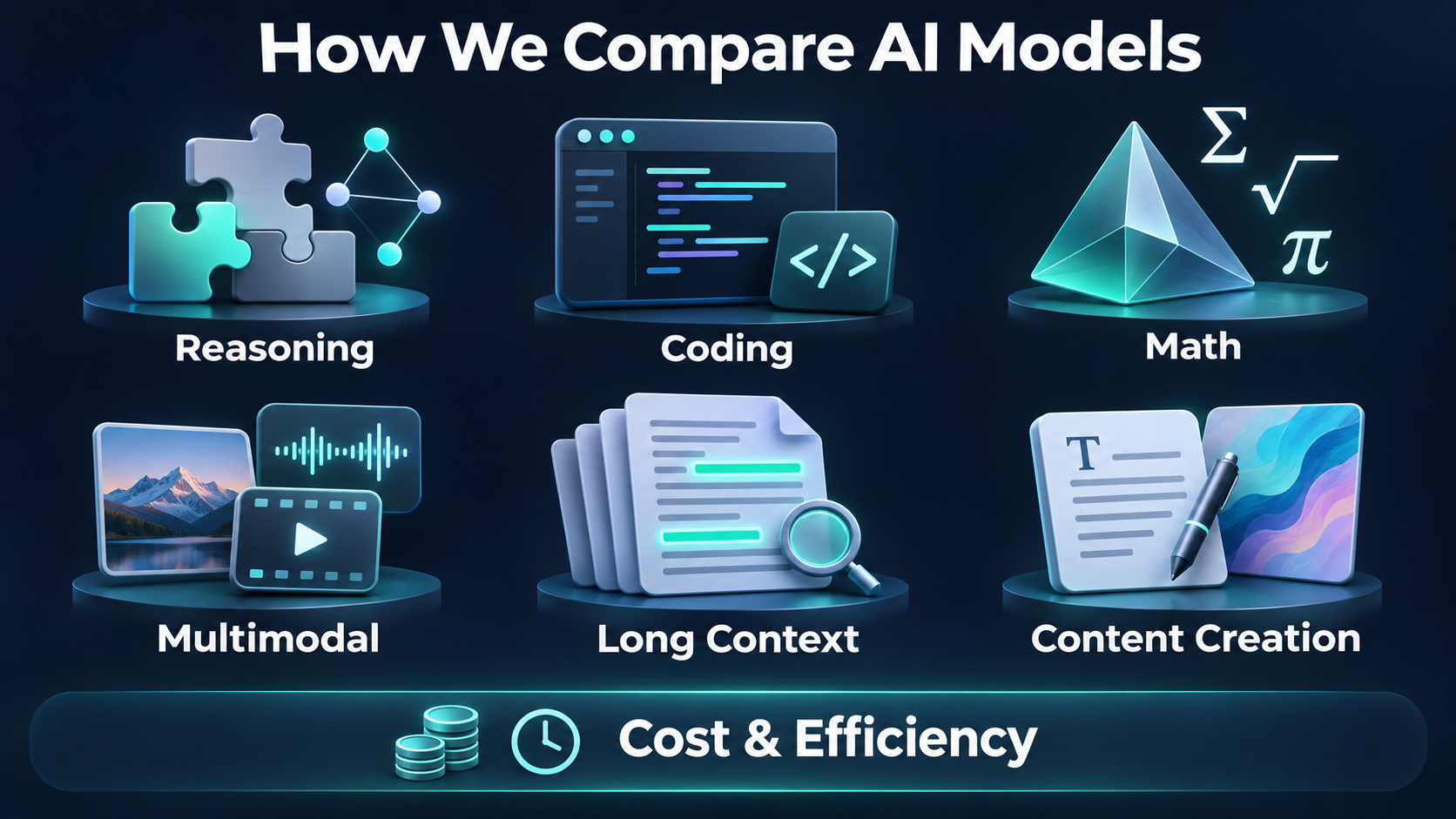
Three questions guide this list: what can the model do, how well does that match your task, and what does a successful result cost?
For reasoning and mathematics, examine correctness and the ability to identify assumptions. For coding, look at working patches and passing tests. For long documents, check whether answers trace back to the supplied material. For multimodal tasks, verify the exact input formats supported by your chosen endpoint. For content creation, assess factual discipline, tone, structure, and revision quality.
Benchmarks provide a useful starting point. The following snapshot uses the rounded Intelligence Index values displayed by Artificial Analysis on November 23, 2026.
| Model configuration | Intelligence Index |
| Claude Fable 5.2, Max, Default Fallback | 65 |
| GPT-6.2 Astra, Max | 62 |
| Gemini 4 Neon, Xhigh | 61 |
| Claude Sonnet 5.5, Max, Default Fallback | 55 |
Scores are index points. Preserve the configuration labels when comparing results. Artificial Analysis evaluates primarily English-language, text-based intelligence; it reports other capabilities separately. The index therefore cannot settle every question about visual understanding, multilingual writing, or your particular workflow.
Provider-reported results add detail, but effort levels, tools, and evaluation environments matter. Our application recommendations are editorial judgments based on published evidence.
Eight Powerful AI Models Worth Considering
1. GPT-6.2 Astra: Broad Capability for Complex Projects
GPT-6.2 Astra is a strong starting point when a project combines analysis, coding, and a finished deliverable. OpenAI positions it for difficult professional work, including documents, spreadsheets, and interactive software.
Consider a research assignment that requires extracting requirements, reconciling conflicting information, and producing a structured recommendation. Astra belongs on the shortlist because these activities demand several kinds of reasoning within one project.
Its standard API price is $8 per million input tokens and $40 per million output tokens. Use it where better task completion can justify that expense. For mathematical work, request assumptions, a concise justification, and an independent numerical check when appropriate.
2. Claude Fable 5.2: Deep Technical and Scientific Work
Claude Fable 5.2 deserves attention for difficult coding and research. Anthropic reports 49.1% on FrontierCode 2.0 at Xhigh effort. That result supports considering it for demanding software changes, while remaining specific to the stated evaluation.
A suitable task might involve diagnosing a recurring failure, tracing its cause across several files, and proposing a patch with regression tests. Give the model the relevant code, constraints, and acceptance criteria.
Fable's standard input and output rates are $8 and $40 per million tokens. Start with a defined task and an appropriate effort setting. Escalate when the additional reasoning improves the deliverable enough to justify the cost.
3. Gemini 4 Neon: Multimodal Analysis and Knowledge Work
Gemini 4 Neon is particularly relevant when information arrives in several formats. Google's announcement describes support for synthesizing spreadsheets, PDFs, charts, audio, and video within a one-million-token context window.
That makes it a candidate for comparing a presentation with a report, explaining a chart, or turning mixed research materials into a structured brief. Specify which source supports each conclusion and ask the model to flag inconsistencies.
Google lists standard input and output prices of $3 and $15 per million tokens. Check the interface's supported inputs before preparing your materials: a model's native capabilities and a third-party endpoint's accepted formats can differ.

4. DeepSeek V4.1 Flash: An Economical Model to Evaluate
DeepSeek V4.1 Flash is worth testing when you need frequent analysis, extraction, or coding assistance. The current official API version is DeepSeek-V4.1-Flash-1017, accessed through the model name deepseek-flash. It supports thinking and non-thinking modes, image input, and a one-million-token context window.
Its standard uncached input and output prices are $0.30 and $1.20 per million tokens during peak periods, falling to $0.15 and $0.60 off-peak.
Those rates make repeated experiments more accessible. Start with tasks whose quality you can verify: extracting fields, checking calculations, or drafting a small function. Include retries and manual correction when judging its overall value.
5. Qwen4-Max: A Candidate for Work and Creative Tasks
Qwen4-Max brings native vision and a one-million-token context window to Alibaba's flagship lineup. Its November announcement emphasizes work, creativity, and research.
Alibaba reports that Qwen4-Max uses 35% fewer tokens than Qwen3.8-Max at High effort on its proprietary Work360 benchmark, with approximately 60% lower average task cost. Treat that as a comparison within Alibaba's test setup; it does not establish equivalent savings on another benchmark.
Try it on a visual research brief, a structured content assignment, or a document comparison. Confirm the exact version and provider price. RunningHub's catalog currently lists Qwen3.8-Max; check Qwen4-Max availability separately.
6. Grok 4.7: Coding and Structured Tool Workflows
Grok 4.7 supports text and image inputs, reasoning, function calling, and structured outputs. These capabilities make it a candidate for software assistance and applications that need predictable response formats.
For example, ask it to inspect an error report and return a structured list of possible causes, the evidence for each, and the next diagnostic step. Tool access must be supplied by the application you use.
Its official starting rates are $2 per million input tokens and $6 per million output tokens. The documentation lists higher-context pricing above 200,000 tokens, so check the applicable tier before sending a large request.
7. Kimi K3.1 Pro: Open-Weight Multimodal Capability
Kimi K3.1 Pro is an open-weight model with text and image inputs and a one-million-token context window. Moonshot's model card highlights improvements in coding, research, and other agentic tasks.
Its published Terminal-Bench 4.0 result is 65.7, evaluated with the Claude Code harness. Keep that environment in view when interpreting the score.
Kimi is worth evaluating for document-heavy research or projects where open weights are an important selection factor. Hosted access offers a practical starting point: its 2.8-trillion-parameter architecture makes local deployment a substantial infrastructure undertaking. Compare hosting cost, available tools, and task quality before choosing a deployment approach.
8. Claude Sonnet 5.5: A Practical Everyday Choice
Claude Sonnet 5.5 is a useful option for well-defined coding and knowledge tasks. Anthropic describes it as a faster, lower-cost complement to Opus 5.5, with a one-million-token context window.
Consider it for fixing a contained bug, reviewing an article, drafting product copy, or organizing supplied research. Clear requirements and examples help you evaluate whether a more expensive model adds meaningful value.
Its standard API rates are $2 per million input tokens and $10 per million output tokens. This combination of capability and price makes it a sensible model to include in everyday comparisons, especially when work involves repeated revisions.
Which Model Fits Your Work?
For complex reasoning and mathematics, begin with Astra, Fable, or Neon. Use problems with verifiable answers, and check both assumptions and calculations.
For difficult coding, compare Astra and Fable; include Kimi when open weights matter. For smaller development tasks, test Sonnet, DeepSeek, or Grok against your existing test suite.
For long documents and mixed media, consider Neon and Kimi, then check endpoint-specific input support. Test retrieval from the beginning, middle, and end of your materials.
For content generation, compare two models using the same brief. Judge accuracy, voice, specificity, and editing effort. Popular AIs become useful when their output fits your requirements consistently.
Explore Leading Models in One Place with RunningHub
A shortlist becomes more useful when you can try it against your own work. Platforms that bring several providers together reduce the effort of moving between separate services. RunningHub offers that convenience, alongside lower listed API rates for selected models.
Its catalog includes Fable 5.2, Sonnet 5.5, Grok 4.7, and Kimi K3.1 Pro, among other options. Check the exact model and route before starting.
Selected Models Cost Less Than Official Standard APIs
The comparison below uses USD per million tokens, with uncached input and ordinary output. Prices were checked on November 23, 2026.
| Model | Official input / output | RunningHub input / output | Reduction |
| Claude Fable 5.2 | $8 / $40 | $6.40 / $32 | 20% |
| Claude Sonnet 5.5 | $2 / $10 | $1.60 / $8 | 20% |
| Grok 4.7, starting tier | $2 / $6 | $1.70 / $5.10 | 15% |
For Sonnet, one million uncached input tokens plus 200,000 output tokens would cost $4 at official standard rates, compared with $3.20 at the listed RunningHub rates. This illustrative calculation excludes caching, batches, tools, and other charges.
Use the RunningHub model catalog to confirm current prices, conditions, and available models. Discounts vary by model and route.
Compare the Same Task Across Models
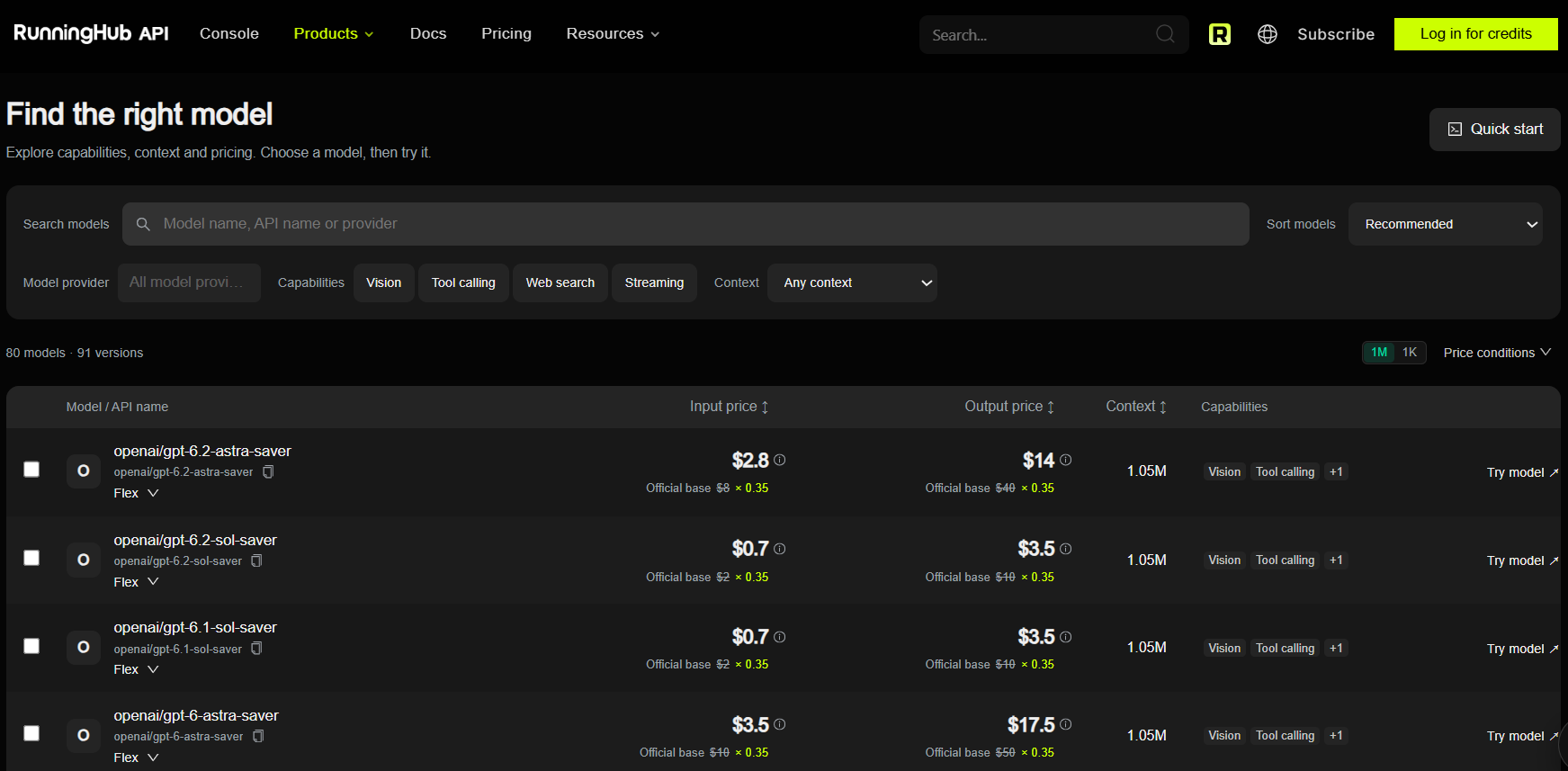
Filter the catalog by provider or capability, inspect the model details, and use the listed “Try model” entry where available. Run the same brief separately on two models, keeping the supplied information and requirements consistent.
For direct LLM API calls, RunningHub requires an Enterprise-Shared API key and supports OpenAI, Anthropic, and Gemini-compatible protocols. Follow the RunningHub API instructions for setup and account requirements.
The practical advantage is flexibility: you can evaluate supported models through one platform, then allocate your budget according to the work each handles well.
Two Prompts for a Useful Comparison
Coding example. Compare Fable 5.2 and Sonnet 5.5 using the text-only prompt below. Use comparable settings where supported, record any differences, and run the returned tests yourself. Check correctness, scope, and the amount of repair required.
Prompt A
Content example. Compare Sonnet 5.5 with Grok 4.7 on this fictional product brief. Use text-only input and evaluate adherence to the facts, distinct ad angles, and editing effort. Replace the supplied details with your verified product information when adapting it.
Prompt B

Frequently Asked Questions
What are some top-tier LLMs?
GPT-6.2 Astra, Claude Fable 5.2, and Gemini 4 Neon are strong frontier candidates. Kimi, Qwen, Grok, DeepSeek, and Sonnet provide additional options for particular tasks, budgets, and deployment preferences.
Which AI model is best for coding and math?
Start by comparing Astra, Fable, and Neon on representative problems. For coding, run tests. For mathematics, verify the answer and assumptions. Model configuration and available tools affect results.
Which popular AIs work well with long documents?
Neon, Kimi K3.1 Pro, and Claude's current models offer large context windows. Check accepted file formats and ask for source references. A large window alone does not establish retrieval accuracy.
Are the most powerful AI models always the most expensive?
Costs depend on token rates, reasoning effort, retries, and correction time. Compare the total cost of completing your task successfully. Selected RunningHub model rates are below official standard API prices.
Can I try multiple AI models through RunningHub?
Yes. Its catalog provides access paths for models from several providers. Availability, supported capabilities, setup requirements, and prices depend on the selected model and route.
Conclusion
The most powerful AI models offer different combinations of reasoning, coding, multimodal understanding, and cost. Astra, Fable, and Neon deserve a place on a frontier shortlist; the other models here expand your options for specific workloads and budgets.
Choose two candidates, give them the same representative task, and compare usable results. RunningHub makes that process more convenient for supported models, while selected discounted API rates leave more room to experiment and refine your work.